Playwright stealth mode is not built into Playwright, and the browser can still be detected even when common stealth patches are applied. In practice, 98.2% of raw Playwright sessions and 100% of stealth-mode browserless.io sessions were detected in one 2026 benchmark, so masking one DOM signal is rarely enough on its own.
Table of Contents
- What Playwright Stealth Actually Means
- Patching the Obvious Signals Safely
- Why JavaScript Patches Alone Keep Failing
- How Engine-Level Identity Control Changes the Game
- Partial Spoofing Versus Layered Hardening
- Building a Coherent Playwright Stealth Workflow
What Playwright Stealth Actually Means
The term Playwright stealth mode gets used loosely, but the mechanics are pretty narrow. It usually means a third-party patch layer that tries to hide automation fingerprints like navigator.webdriver, headless-specific user-agent strings, missing plugins, and unrealistic WebGL or codec values, rather than a feature that ships with Playwright itself as described in this browser fingerprinting write-up. That distinction matters, because the patch often changes what the page sees without changing what the browser stack leaks underneath.
The practical definition
A lot of guides treat stealth like a switch. Turn it on, and the site stops asking questions. In practice it is messier, because patched JavaScript values can still sit on top of a browser that looks automated at the network or protocol layer. A useful companion to that framing is WebscrapingHQ's Playwright anti-bot overview, which is helpful precisely because it treats stealth as one control in a larger defense stack.
Practical rule: if the target site only checks
navigator.webdriver, a patch may help. If it correlates browser, transport, and behavior signals, the same patch can fail cleanly.
That's why this topic keeps resurfacing in scraping and QA teams. People don't just want to hide automation, they want coherent identity. The difference shows up when a detector page passes but the target still blocks the session, which is why a more grounded alternative like Clearcote's Playwright Stealth alternatives overview belongs in the discussion alongside the usual plugin advice.
What the patches are actually trying to change
The usual targets are browser-visible signals, not the full identity stack. That includes properties exposed through the DOM, browser APIs, and some profile-level expectations like plugins or codec availability. In other words, the patch aims to make the session look less like an automation harness and more like a human-controlled browser.
The problem is that detectability rarely lives in one property anymore. Modern anti-bot stacks compare several layers at once, so a patch that fixes one field can create a new mismatch somewhere else. That is why “stealth” keeps meaning “partially hidden” rather than “undetectable.”
Patching the Obvious Signals Safely
The safest first move is still to clean up the obvious JavaScript-visible tells. That means normalizing navigator.webdriver, aligning the user-agent with the browser you are running, and making sure basic expectations around plugins, fonts, and canvas behavior don't look frozen or synthetic. Those fixes don't solve everything, but they reduce the easiest triggers.

Start with the DOM-facing checks
A stable baseline usually begins before the page scripts run. If you're patching through Playwright, keep the scope narrow and consistent, because every extra interception point increases the chance of a mismatch. The goal isn't to simulate every possible browser quirk, it's to avoid the most obvious automation signatures without introducing contradictions.
A sane baseline focuses on:
navigator.webdriverremoval: eliminate the most common automation flag, but don't assume this alone changes the outcome.- User-agent alignment: keep the browser version, platform, and headless or headed state internally consistent.
- Plugin and language expectations: avoid empty or unrealistic arrays if the target checks them.
- Canvas and WebGL sanity: don't let these values look impossible for the claimed browser and OS.
That list is intentionally modest. Every extra layer you touch creates more maintenance, especially when the same site tests the values across multiple execution contexts.
Keep the patch set small enough to debug
Heavy interception sounds thorough, but it usually gets hard to debug quickly. If a site starts blocking after a patch, you need to know which value drifted, which context diverged, and whether the failure is in the page, worker, or iframe. Large patch bundles blur that line and make regressions harder to isolate.
If a detector passes in isolation but the target still blocks, treat that as a coherence problem, not a single broken field.
A disciplined workflow is to test each patch against the smallest possible page surface first, then move outward. That's the part most organizations skip. They stack evasion tweaks, declare success when the browser starts, and only discover the inconsistency later when the session gets flagged on a real site.
Why JavaScript Patches Alone Keep Failing
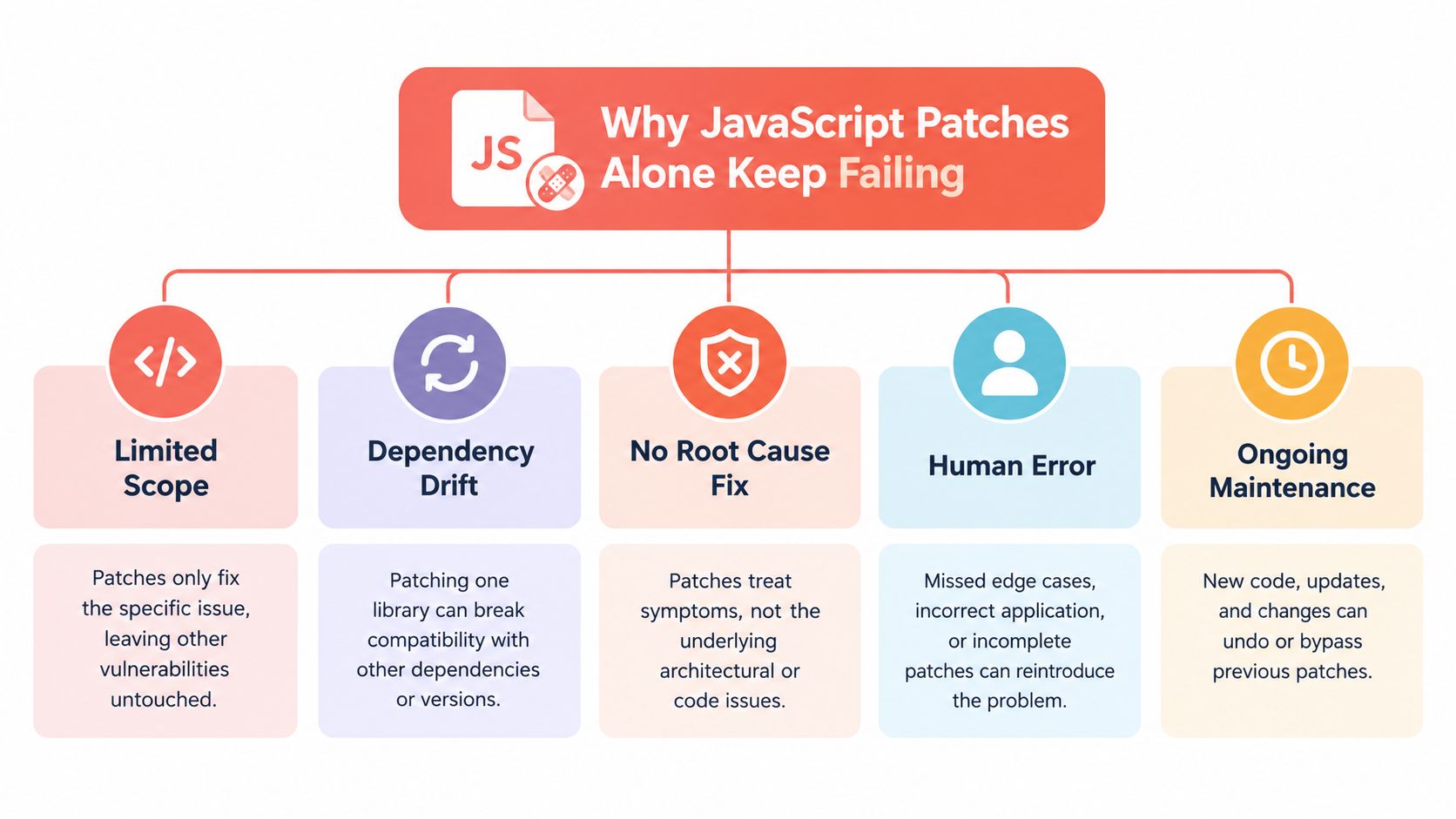
JavaScript patches only affect one layer of the stack, and modern detection systems look across several. Playwright stealth can hide browser-level signals, but it does not change IP reputation, TLS fingerprinting, behavioral analysis, or advanced challenge flows. A browser automation comparison noted that Playwright's Chromium binary can expose distinct JA3 and JA4 fingerprints, along with CDP protocol signals, which means the browser can still identify itself outside the DOM in this browser automation comparison.
Cross-realm inconsistency is the silent failure mode
A value that looks correct in the main thread can drift in a worker or iframe. Detectors do not need a perfect single signal. They only need one contradiction. Clearcote's layer-by-layer detection research frames the problem correctly, because the issue is coherence, not one isolated plugin or property.
That same coherence problem shows up below the JavaScript layer. If the page claims one identity while the browser behaves differently on the wire, the session stops looking like a real user session. A patch that never reaches transport or protocol behavior still leaves a classifier enough evidence to score the run as automation.
Transport and protocol signals matter more than most guides admit
Modern detection stacks compare TLS details, HTTP behavior, and automation protocol artifacts, then weigh those against browser-visible signals. A direct-CDP approach outperformed patched Playwright in the benchmark set described in the same browser automation comparison, which shows how little a page-only patch set can change once the browser is examined from the network side in this browser automation comparison.
The practical takeaway is straightforward. If you only patch JavaScript, you are changing the presentation layer while leaving the transport and automation footprint intact. That is why a detector page can look clean and the target site still reject the session.
Watch the video on YouTubeHow Engine-Level Identity Control Changes the Game
The reason engine-level control works better is that it moves identity into the same place the browser generates it. Identity signals are set in C++ paths, not injected JavaScript, so the browser can keep main thread, workers, and iframes consistent while also aligning network-layer fingerprints with the claimed browser version. That coherence is what surface patches usually miss.

What a coherent identity looks like
A coherent persona has the same story everywhere. The browser values, the TLS and HTTP/2 behavior, and the rendering output all point to the same underlying device model. Seeded identities make that repeatable, because the same seed yields the same device and a different seed stays unlinkable by design.
That matters for QA, scraping fleets, and repeatable agent runs. If a team needs the same persona to behave the same way across reruns, engine-level control is far easier to reason about than a bundle of page scripts that only affect one context.
You can see the same logic in browser verification tooling such as Scrapfly's browser fingerprint test guide, where the point is not just to check a single field but to see whether the profile holds together as a whole.
Why this matters more than clever spoofing
Real-GPU canvas bridges align read-back pixels with the persona's claimed GPU, which closes one of the common gaps left by generic spoofing. Proxy geo-matching also keeps timezone, languages, and WebRTC aligned with the exit IP automatically, so the browser doesn't say one thing while the network says another.
That kind of alignment is what makes identity control useful across broader browser matrices. It's not just about avoiding one flag, it's about preventing the browser from contradicting itself at every layer. The moment those values drift apart, stealth becomes a liability instead of a fix.
Useful heuristic: the less your browser, network, and persona agree, the easier it is to classify.
For teams comparing options, the Clearcote Labs verification workflow is relevant because it treats the browser as an identity system, not a collection of unrelated overrides. That's the operational difference between “patched” and “coherent.”
Partial Spoofing Versus Layered Hardening
Analysts in the measurement report found that evasive bot traffic was still detected at scale in a half-million-request honey-site study. DataDome detected 55.44% of requests and BotD detected 47.07%, which leaves evasion rates of 44.56% and 52.93% from the measurement report. Partial spoofing still leaves a large share of traffic visible, even when it works.
What happens when only one layer changes
A single fingerprint modification was still blocked on 29.5% of evaluated websites. More extensive fingerprint modifications reduced that to 2.5% in the same measurement. That gap is the argument against superficial stealth workflows. Changing one field can help, but it often does not change the overall identity story enough to matter.
| Modification Level | Typical Detection Rate |
|---|---|
| Single fingerprint change | 29.5% blocked |
| More extensive fingerprint changes | 2.5% blocked |
Those numbers do not make deeper spoofing a silver bullet. They show that coherence across identity, browser, and network signals changes outcomes in a way isolated patching usually does not.
Why layered hardening beats patch stacking
A 2026 study found that combining network, HTTP, and browser-layer fingerprints reached 0.931 accuracy/F1 with near-perfect classification for most web agents in the arXiv study. Detectors can rely on agreement across layers, not just one notorious DOM property. Stealth mechanisms can make things worse if they introduce inconsistencies between those layers.
The detector does not need perfection. It needs a contradiction.
That is why regression testing matters as much as the patches themselves. Validate the full identity path, not just the obvious browser flags, and rerun those checks whenever the browser build, proxy path, or automation framework changes.
Building a Coherent Playwright Stealth Workflow
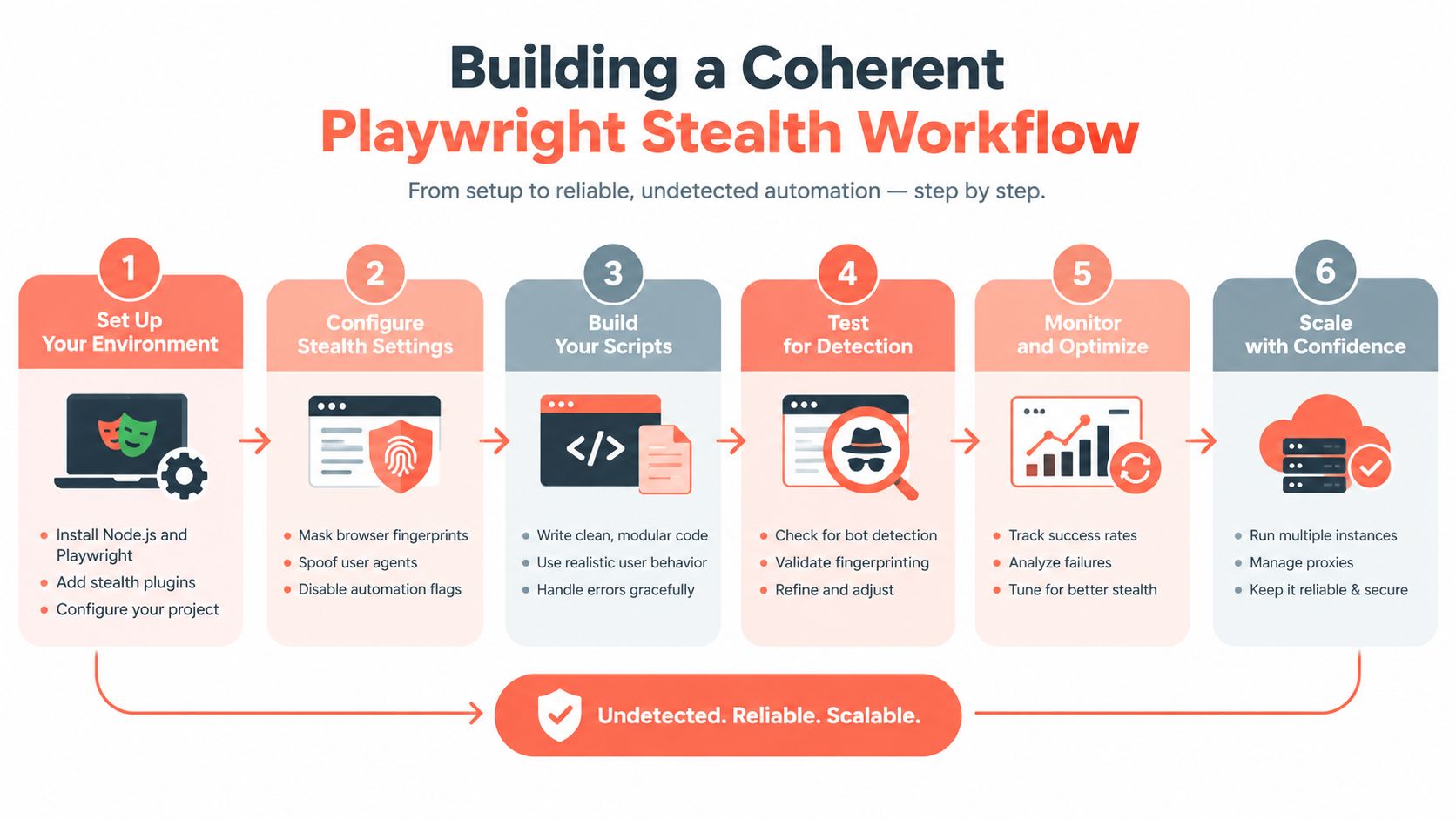
A workable workflow starts with coherence, not concealment. If identity, transport, and browser behavior do not line up, modern detection stacks find the mismatch faster than any single patch can hide it. The stronger approach is to pair baseline browser fixes with engine-level identity control, then verify the full path whenever the stack changes.
A practical operating sequence
Start by deciding which layer you need to control. If the target only checks a small set of browser flags, a narrow patch set can be enough. If the site compares signals across layers, use a browser build or runtime that keeps the profile aligned across engine, transport, and context.
Then validate in the same order the detector is likely to use:
- Browser surface: check visible automation flags, user-agent alignment, and context values.
- Context coherence: compare main thread, workers, and iframes.
- Transport consistency: confirm TLS, HTTP, and browser version alignment.
- Behavioral sanity: watch whether interaction timing and navigation patterns look stable.
- Regression control: rerun tests after every browser, proxy, or framework change.
A hosted browser can help when you want stable infrastructure without maintaining the browser fleet yourself. For teams that need engine-level fingerprints and reproducible personas, Clearcote Labs is one option, since it provides a browser build with fingerprint and identity controls compiled into the engine and can run locally, in Docker, or as a hosted browser.
Treat stealth like an ongoing control, not a setup task
The biggest mistake is treating stealth as finished once a fingerprint test passes. Detection rules change, browser behavior changes, and a proxy or runtime shift can break alignment between layers. If you stop validating end to end coherence, you end up with a session that looks clean in one tool and suspicious everywhere else.
For long-running scraping, QA, or agent systems, the discipline is simple. Keep the persona seeded, keep the transport consistent, and keep the browser build under regression testing. That is what turns Playwright stealth mode from a brittle patch stack into something you can maintain.