
The most popular advice for web scraping at scale is also the easiest way to build an expensive failure machine: add workers, rotate more proxies, and increase request volume until the target gives up. That approach treats access as a bandwidth problem. In production, it's usually an identity-coherence problem.
A crawler can issue requests quickly and still produce a poor dataset. Common Crawl's history illustrates the engineering reality. Its archive grew from an experimental crawler launched in 2008 to a globally distributed corpus exceeding 9.5 petabytes by mid-2023, while a reported 2025 crawl contained roughly 3.0 billion pages and 460 tebibytes of uncompressed content. At that scale, scheduling, storage, deduplication, retries, parsing, host politeness, and data validation matter as much as fetching. AWS's account of Common Crawl's evolution makes the central point clear: large-scale scraping is data engineering, not browser automation with a bigger loop.
Table of Contents
- Why More Workers and More Proxies Stop Working
- The Data-Engineering Core of a Scraping Pipeline
- Choosing a Proxy and Residential IP Strategy
- Hosted Browsers Versus Engine-Level Identity
- A Realistic Cost Model for Web Scraping at Scale
- Detecting Silent Corruption and Defining Content SLOs
- Architecture Checklist for Your Next Scraping Project
Why More Workers and More Proxies Stop Working
A rotating IP address changes only one part of a request's identity. Modern targets can correlate the TLS handshake, HTTP/2 behavior, headers, browser version, JavaScript-visible properties, session history, and request cadence. If those signals disagree, changing the IP often makes the fleet look less natural, not more.
Datacenter proxies demonstrate the trap. They're fast, inexpensive, and easy to provision, but their network ownership and traffic patterns can be clustered. Residential IPs reduce some network-level correlation, yet they don't automatically make a browser profile consistent with the claimed location, operating system, locale, or protocol stack. A residential exit paired with a mismatched Chromium identity is still a suspicious session.
Identity coherence is the real unit of scale
I define an identity as coherent when the following signals tell the same story:
- Network location: The IP geography, timezone, language preferences, and WebRTC behavior agree.
- Protocol identity: The TLS and HTTP/2 characteristics match the claimed browser version.
- Browser surface: User agent data, client hints, canvas, WebGL, audio, fonts, and workers remain consistent across realms.
- Session behavior: Navigation, pauses, retries, cookies, and concurrency follow a plausible cadence.
- Data behavior: The session requests related resources in a sequence that fits the page and task.
Adding another worker without controlling these relationships increases the number of inconsistent combinations. More concurrency can therefore raise challenge rates while leaving the usable yield unchanged. The important metric isn't requests per second. It's valid, correctly parsed records per unit of infrastructure.
Practical rule: Treat an IP, browser engine, profile, and session schedule as one identity object. Don't procure them as unrelated components.
The operational consequences show up in challenge handling, too. A worker that receives a 200 OK page may still have received a block page, an incomplete application shell, or a consent wall. The Clearcote challenge documentation is useful context for separating browser access problems from extraction and validation problems.
A coherent identity won't make every target accessible, and it doesn't remove the need to respect robots rules, terms, rate limits, or privacy obligations. It does change the architecture review. Instead of asking how many workers or proxies to buy, ask whether each session presents a stable and reproducible explanation for its network, browser, and behavior.
The Data-Engineering Core of a Scraping Pipeline
The browser gets attention because it's visible. The queue, state store, retry policy, and raw-data layout determine whether the system can survive a broken host, a worker crash, or a parser regression.
Use a fleet of 200 workers across 40 domains as a planning example, not as a target throughput promise. The correct design doesn't give every worker a global list of URLs. It gives each host a controlled lane and lets a scheduler allocate work inside those boundaries.
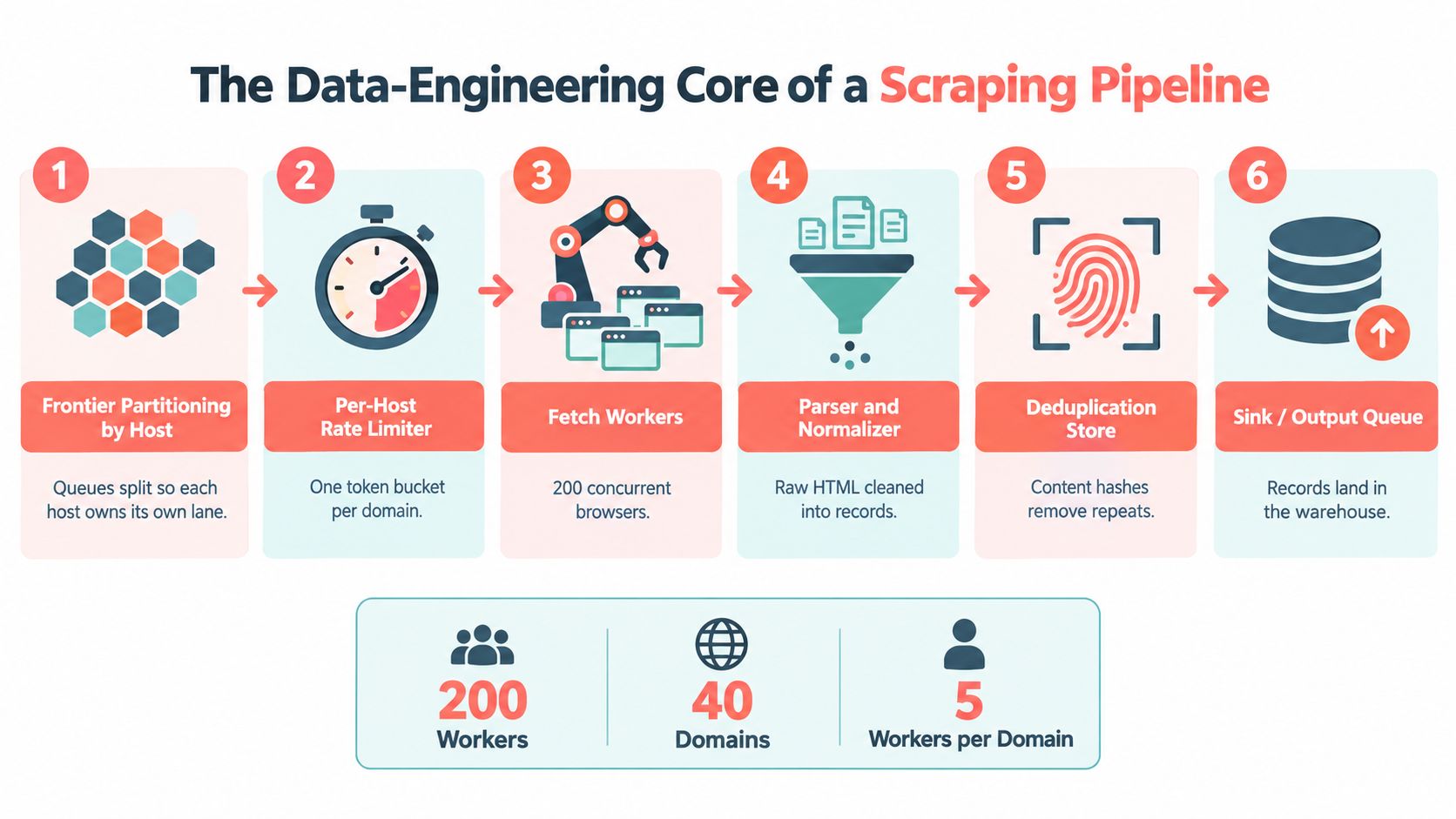
Partition the frontier before you optimize workers
Partition queues by host or domain. A slow or defensive host can then exhaust its own leases without filling the global queue with timeouts. The scheduler should enforce aggregate host budgets, not just limits inside each worker. Otherwise, a nominally polite worker pool can become aggressive when several workers target the same domain.
Every URL should pass through canonicalization before enqueueing. Normalize casing where appropriate, remove tracking parameters according to target-specific rules, resolve known aliases, and store a durable fingerprint. Pair the normalized URL with a body hash after retrieval. URL deduplication prevents duplicate fetches, while content-addressed storage catches different URLs serving the same document.
Common Crawl's 2025 release contained approximately 2.6 billion pages, data from about 47.6 million hosts, and around 1 billion URLs not present in previous archives. That combination of breadth and novelty explains why a production frontier needs durable fingerprints, historical indexes, and prioritization rather than an ever-growing list. Common Crawl's release data shows why discovery, revisiting, and freshness must compete for explicit budget.
Give every host a politeness budget
Use a token bucket or equivalent host-level limiter. The scheduler should consume tokens for requests, account for redirects and rendered assets where relevant, and pause a lane when latency or errors rise. Honor robots.txt and any stated crawl delay before requesting page content.
Store leases, attempt counts, response metadata, redirect chains, timing, and worker ownership. A crashed worker must release work without creating a duplicate burst. A healthy scheduler should also distinguish these retry classes:
- Transient network failures: Timeouts, connection resets, and selected server errors receive exponential backoff with jitter.
- Structural changes: A valid response that fails schema checks enters a parser review or replay queue, not an endless network retry.
- Permanent refusals: Malformed URLs, explicit access denials, and many client errors normally stop retrying until a human or policy change authorizes another attempt.
A documented large crawl recorded 162 million network errors and 6.7 million HTTP failure conditions, which is why an overall HTTP success rate hides too much. The large-scale crawl analysis supports dashboards broken down by host, error class, and attempt number.
Separate replayable raw data from trusted records
Write every response and its metadata to a raw landing zone keyed by crawl or run identifier. Keep it immutable enough to replay a parser without hitting the target again. Promote records into a curated zone only after schema checks, required-field validation, content-type checks, and duplicate detection pass.
This two-stage layout prevents a parser deployment from silently rewriting the only copy of the source response. It also lets you compare parser versions against the same input, which is far cheaper and safer than asking a target to serve the page again.
Watch the video on YouTubeChoosing a Proxy and Residential IP Strategy
Proxy selection should begin with the target's access behavior, not a vendor's pool size. The relevant question is how much each successful record costs after failed requests, session resets, bandwidth, support work, and data-quality review.
Datacenter proxies remain useful for open, static targets where speed and predictable routing matter. Their weakness is recognizable network concentration. Residential pools offer broader network diversity and can help with location-sensitive retail or travel workflows, but they introduce higher bandwidth costs, provider policy constraints, variable latency, and more complex consent and provenance requirements. Hosted browsers bundle routing, rendering, and part of the identity layer, which reduces operational work but limits low-level control.
| Dimension | Datacenter | Residential | Hosted Browser |
|---|---|---|---|
| Ban exposure | Higher on protected targets | Lower network correlation, target-dependent | Managed as part of the runtime, target-dependent |
| Request economics | Usually lowest raw network cost | Higher bandwidth and provider cost | Billed through runtime or bandwidth model |
| Operations | You manage routing, health, and escalation | You manage pool quality, geography, and session policy | Provider manages much of the fleet |
| Identity floor | IP diversity alone | IP diversity plus geography | IP, browser, and rendering are more closely coupled |
| Best fit | Open HTML and controlled environments | Location-sensitive or moderately protected workflows | Browser-heavy targets where maintenance dominates |
The phrase “successful request” needs a strict definition. A response that loads an interstitial or a partial shell isn't a success just because the transport layer returned a status. Track usable content by host, route, identity, and parser outcome.
Match rotation to session semantics
Rotating on every request can destroy cookies, cart state, login continuity, and behavioral plausibility. Sticky sessions are often more reliable for workflows that require navigation across related pages. Conversely, a long-lived identity can accumulate a reputation problem or become unsuitable after a target changes its challenge policy.
Use escalation rather than universal residential routing. Start with the least complex access method that meets the target's rules, then move a specific host or workflow to a different network class when measured yield justifies it. For teams comparing lead-enrichment and prospecting workflows, can you replace Apollo provides useful context for evaluating whether direct collection is even the right data acquisition path.
A proxy pool also needs a health model. Record connection latency, refusal patterns, geographic consistency, session survival, and usable-content yield. Don't rank exits by HTTP status alone. A fast exit that returns a challenge page is less valuable than a slower exit that produces validated records.
The proxy implementation guidance is relevant here because routing and browser identity should be reviewed together. A proxy decision that ignores TLS, locale, WebRTC, and browser version leaves the central coherence problem unresolved.
Hosted Browsers Versus Engine-Level Identity
There are three practical identity layers. The first is a self-hosted Chromium build that your team patches and operates. The second is a standard headless browser with JavaScript-level modifications. The third is an engine-level fork where identity-sensitive behavior is controlled inside the browser implementation.
Vanilla headless configurations with surface-level spoofing are attractive because they're quick to start. They tend to fail when a target compares values across workers, iframes, canvas paths, WebGL, audio, client hints, and the network stack. A JavaScript shim can change what one page sees without changing what another execution context or protocol layer reports.
Compare control with leakage
| Dimension | Self-hosted Chromium | Headless plus patches | Engine-level fork |
|---|---|---|---|
| Control | High, with substantial ownership | Moderate, concentrated in scripts and launch flags | High for supported engine signals |
| Signal leakage | Depends on patch quality and release discipline | More likely across realms and protocol layers | Lower when controls share one engine implementation |
| Operations | Browser builds, patches, profiles, and fleet upkeep | Script maintenance and target-specific exceptions | Fork maintenance, reproducible releases, and profile management |
| Detection footprint | Can be coherent if carefully maintained | Often exposes mismatched surfaces | Designed around cross-surface consistency |
| Appropriate use | Specialized environments and internal testing | Simple automation or low-friction targets | Repeated identities and multiple target classes |
Self-hosted Chromium works when the team can maintain patches, test every release, and accept that browser engineering becomes part of the product. It offers control, but the cost appears as ongoing compatibility work rather than a single implementation task.
Engine-level control changes the boundary. Canvas, WebGL, audio, fonts, locale, and related values can be generated from the same seeded persona. TLS and HTTP/2 behavior can then be aligned with the browser version instead of patched independently at the page layer. That coherence is more important than adding another spoofing script.
When the fork earns its complexity
A maintained engine-level fork becomes compelling when a team runs multiple target classes or rotates identities often enough that per-session consistency matters more than the cheapest individual request. The exact break-even point depends on target friction, engineering capability, and the cost of bad data. It shouldn't be decided by browser minutes alone.
Hosted browsers trade low-level control for less fleet work. They can be appropriate when the team needs browser execution, geographic routing, and persistent sessions but doesn't want to maintain a distributed browser runtime. Self-hosting remains preferable for strict data residency, custom instrumentation, or workflows that need unusual browser extensions and debugging access.
The hosted browser documentation is a useful reference when comparing a managed runtime with a browser fleet your team operates directly. The right choice is the one that keeps identity, network behavior, and browser release management under a single accountable boundary.
A Realistic Cost Model for Web Scraping at Scale
A useful scraping budget has three columns: build cost, run cost, and failure cost. Teams usually estimate compute and proxies, then discover that identity maintenance, parser repair, replay work, and false records consume the margin.
Consider a recurring product corpus spanning static pages, JavaScript-heavy pages, and sessions that require browser state. The important question isn't whether the fleet can fetch the full URL list. It's whether the system can produce validated records while preserving enough raw material to replay failures.
| Cost line | In-house fleet | Hosted browser | Notes |
|---|---|---|---|
| Build cost | Higher upfront engineering ownership | Lower infrastructure ownership, integration work remains | Includes identity, scheduling, storage, and parser foundations |
| Network cost | Separate proxy contracts and bandwidth | Bundled or metered through the runtime | Compare cost per usable record, not request |
| Browser compute | You size and operate the fleet | Provider allocates browser capacity | Rendering, idle sessions, and concurrency affect the bill |
| Identity maintenance | Your team tracks browser and detection changes | Provider maintains the runtime boundary | Verify how much control and evidence you retain |
| Failure cost | Replays, false records, incidents, and target friction | Shared provider limits, integration failures, and vendor dependency | Price the impact of unusable data |
| Observability | You build dashboards, alerts, and quarantine flows | You still need output-quality monitoring | Managed access doesn't validate extracted fields |
Hosted infrastructure can amortize browser release work and identity maintenance into a usage charge. That can beat in-house operation when the team spends more time repairing access than improving extraction. It can also cost more when pages are simple, traffic is predictable, and the organization already owns a mature browser platform.
Put identity maintenance on the spreadsheet
The quiet budget multiplier is retooling. A target changes a challenge flow, a browser release changes a protocol signal, or a profile stops matching its stated geography. Engineers then adjust launch parameters, proxy rules, session persistence, and parser fallbacks. None of that appears in a per-page estimate unless the model explicitly includes it.
Failure cost is broader than a retry. A stale price can trigger a bad alert. A malformed product record can contaminate a warehouse. An aggressive crawler can damage a relationship with a data source. A defensible model assigns a review and replay cost to every class of failure, even when that number is initially qualitative.
Budgeting principle: If a failure can create a false business decision, price it as a data incident, not as an extra request.
Use staged capacity planning. First measure raw transport yield. Then measure rendered-page yield. Finally measure schema-valid records and freshness by field. This exposes where money is going. Extra workers won't fix a parser bottleneck, and extra proxies won't fix a browser identity mismatch.
The cheapest architecture is the one that minimizes the cost of a usable, reproducible record. Sometimes that's a self-hosted HTTP crawler. Sometimes it's a browser fleet. Sometimes a hosted runtime is rational because it absorbs the maintenance work that your team would otherwise repeat every week.
Detecting Silent Corruption and Defining Content SLOs
The most dangerous scraper failure looks healthy in infrastructure dashboards. Requests return successfully, queues drain, and parsers emit records. The extracted price, availability, or location field is wrong.
A representative incident might begin after a target runs an A/B test. A subset of pages returns a cached or stale value while retaining the expected markup and status. A selector still matches, so the parser reports success. Without content-level checks, the dataset quietly degrades.
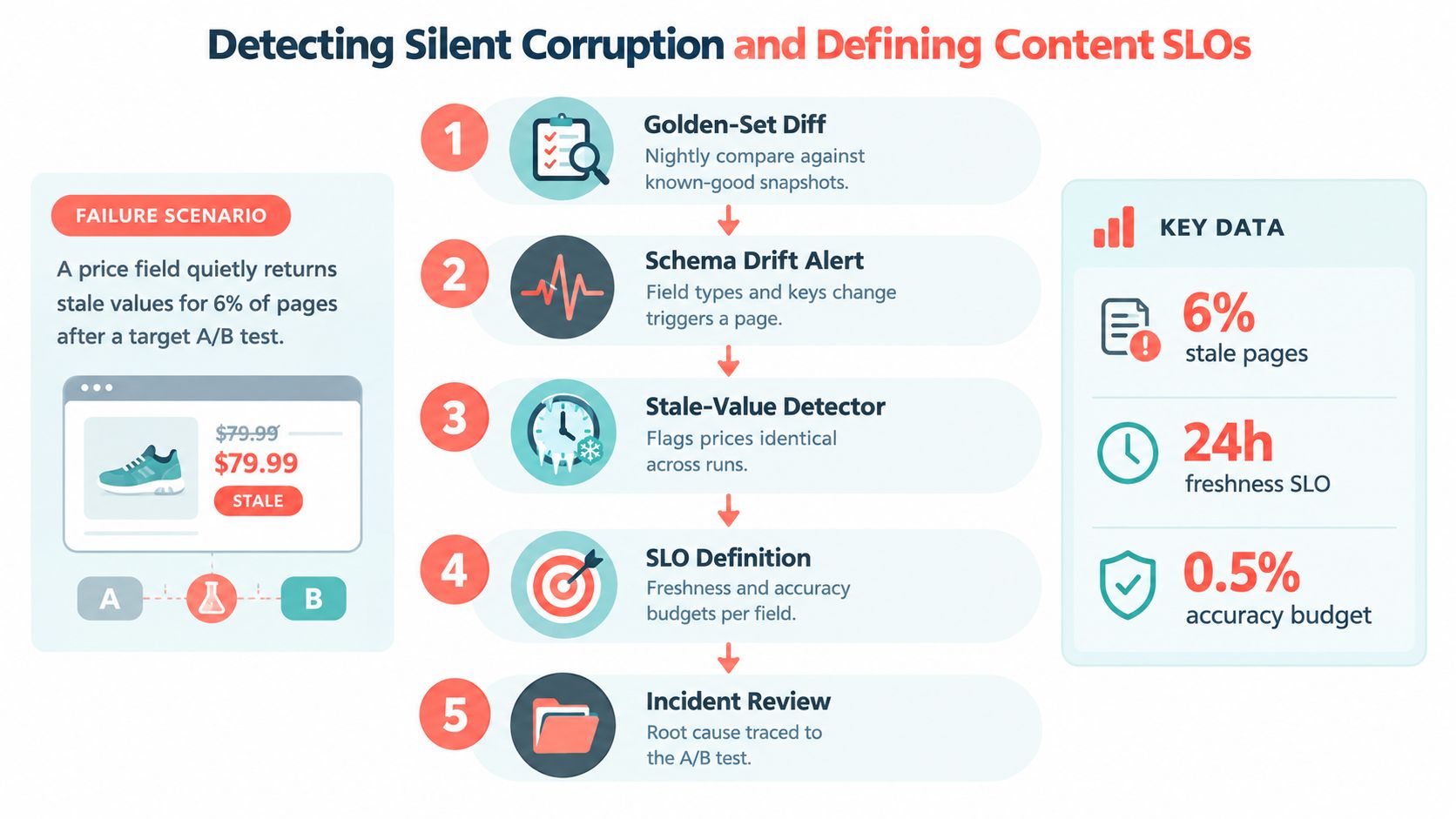
Validate meaning, not just shape
Maintain a golden set of known-good responses and compare them after browser, parser, or target changes. The set should cover page templates, locales, device profiles, and expected edge cases. A structural diff catches missing containers. A semantic diff catches a price that remains unchanged across runs when the surrounding page has changed.
A content SLO should define acceptable behavior for each field class:
- Parse success: The document reaches the expected parser branch.
- Required-field presence: Critical fields appear with the expected type and format.
- Value checks: Prices, dates, quantities, and identifiers satisfy domain constraints.
- Freshness: Volatile fields meet a defined recency window, while stable fields can use a different window.
- Provenance: Every record retains its source URL, collection time, response metadata, identity, and parser version.
The SLO should measure usable records, not HTTP success. A crawl can have excellent transport availability and poor content quality. That distinction is especially important for JavaScript-heavy sites, localized pages, and targets that vary their response by region.
Quarantine before promotion
When a record violates a content SLO, put it in quarantine. Keep the raw response, diagnostics, page fingerprint, and parser version. Don't overwrite the last trusted record until a replay or review establishes that the new value is legitimate.
A strong quarantine workflow has four paths:
- Automatic replay: Retry with the same identity and stored session context when the failure appears transient.
- Alternate rendering: Use a controlled browser path when the response is an incomplete shell or client-side error.
- Parser review: Route consistent schema changes to a versioned parser workflow.
- Manual disposition: Preserve evidence when the target returns a challenge, refusal, or ambiguous document.
Content validation matters because access denials aren't the only coverage problem. One analysis found that nearly 80% of fully qualified domain names always blocked Common Crawl, while a separate browser-fingerprinting crawl of 20,000 sites failed on 1,700 sites, with HTTP 403 accounting for 64.3% of those failures. The coverage analysis illustrates why teams must classify refusals separately from parser defects and temporary outages.
A scraper's failure budget should therefore cover stale values, missing fields, unexpected templates, and cross-region disagreement, not just downtime. Once suspect records are quarantined and replayable, a silent corruption event becomes a bounded incident instead of a slow erosion of trust.
Architecture Checklist for Your Next Scraping Project
An architecture review should be boring. A small team should be able to answer each question with yes, no, or one sentence, then record the consequence of the decision. If the review depends on one engineer remembering an undocumented proxy rule or parser exception, the system isn't reproducible yet.
Identity coherence
- Does the IP geography agree with locale, timezone, language, and WebRTC behavior?
- Does the TLS and HTTP/2 profile match the claimed browser version?
- Are browser values consistent in the main page, workers, and iframes?
- Does each seeded identity produce repeatable values across sessions?
- Are cookies and session state retained for workflows that need continuity?
- Is rotation tied to session semantics rather than a universal timer?
- Can the team explain which signals change when an identity changes?
The non-obvious trade-off is repeatability versus unlinkability. QA and replay need stable identities. High-risk collection may require different identities, but random variation without a coherent persona creates its own detection surface.
Frontier and scheduling
- Is the frontier partitioned by host or domain?
- Does each host have an explicit politeness budget?
- Are
robots.txtdecisions stored with the crawl state? - Are URL canonicalization and deduplication applied before enqueueing?
- Are leases durable across worker failure?
- Are transient, structural, and permanent failures separate?
- Can the scheduler pause one host without starving unrelated work?
A global queue is simple to write and difficult to operate. Host ownership gives failures a boundary and makes capacity visible.
Proxy and network layer
- Is a datacenter pool sufficient for the least protected target?
- What evidence justifies residential routing for a specific host?
- Does the proxy's geography agree with the browser persona?
- Is session stickiness explicit?
- Are proxy health and usable-content yield measured separately?
- Is escalation triggered by evidence rather than by default?
- Are provider terms, consent requirements, and retention controls documented?
A proxy pool is not an identity system. It's one dependency inside one.
Runtime and parsing
- Is plain HTTP enough for the page class?
- Which workflows require JavaScript execution?
- Does the team need self-hosted Chromium, patched headless mode, an engine-level fork, or a hosted browser?
- Are browser and parser versions recorded with every response?
- Are schemas versioned?
- Do selector fallbacks produce diagnostics rather than silent guesses?
- Can a stored raw response be parsed again without a new fetch?
Keep extraction deterministic where a database field needs deterministic behavior. Use probabilistic methods only with validation and quarantine appropriate to their uncertainty.
Cost, compliance, and observability
- Is the budget based on validated records rather than requests?
- Are bandwidth, browser time, retries, and engineering maintenance visible?
- Are public personal-data fields classified by sensitivity and purpose?
- Are collection time, source terms, retention, and deletion handling recorded?
- Are freshness and completeness SLOs defined per field class?
- Are challenge pages and incomplete shells detected?
- Does an incident retain raw evidence and support replay?
For teams building ingestion systems, these controls belong beside broader data streaming best practices, especially around lineage, replay, schema evolution, and operational ownership.
The kill criteria should be written before production. Walk away from a target when it imposes persistent login walls you can't legitimately satisfy, identity signals drift despite mitigation, or content SLOs remain breached for three consecutive weeks. A target that consumes endless engineering time and still produces unreliable data isn't a scaling opportunity.
Clearcote Labs offers an open-source Chromium fork, Playwright and Puppeteer SDKs, reproducible browser identities, Docker and CDP deployment options, and hosted browsers with residential routing for teams that need tighter control over browser identity at scale. If your current fleet mixes incompatible browser, proxy, and session signals, visit Clearcote Labs to evaluate an identity-coherent runtime for your next scraping project.