
In a large-scale crawl, 98.2% of canvas-fingerprinting scripts came from third-party websites, not the publishers whose pages visitors opened, according to follow-up measurements of canvas tracking. That changes the engineering question. Canvas fingerprinting isn't just a browser API that reveals something about your device. It's a rendering signal collected through embedded infrastructure, and changing its pixels doesn't necessarily stop an observer from recognizing your environment.
For developers using Playwright or Puppeteer, the harder problem is coherence. Does the browser return compatible results across pages, workers, and frames? Do those results agree with its graphics capabilities, fonts, and claimed identity? A defense can pass a canvas-hash test while failing that broader examination.
Table of Contents
- How Canvas Fingerprinting Became a Real Tracking Surface
- What the Browser Actually Does When You Read a Canvas
- Entropy and Stability of Canvas Fingerprints
- The Coherence Problem Across Browser Realms
- Why JavaScript Defenses Keep Falling Short
- Engine-Level Controls and How Clearcote Approaches Coherence
- Choosing the Right Defense by Threat Model
How Canvas Fingerprinting Became a Real Tracking Surface
Canvas fingerprinting's feasibility was demonstrated in 2012. A later landmark measurement found it on 5,542 of the Alexa top 100,000 websites, approximately 5.5%, with about 95% of observed activity attributed to AddThis, as documented in the academic history of canvas fingerprinting.
Those milestones shouldn't be collapsed into a single event. Researchers first demonstrated that rendering differences could distinguish environments, then measured deployment in the wild. The important transition wasn't that someone could generate a fingerprint. Third-party providers had incorporated the technique into code that publishers reused.
The timeline illustrates that transition from research to embedded tracking.
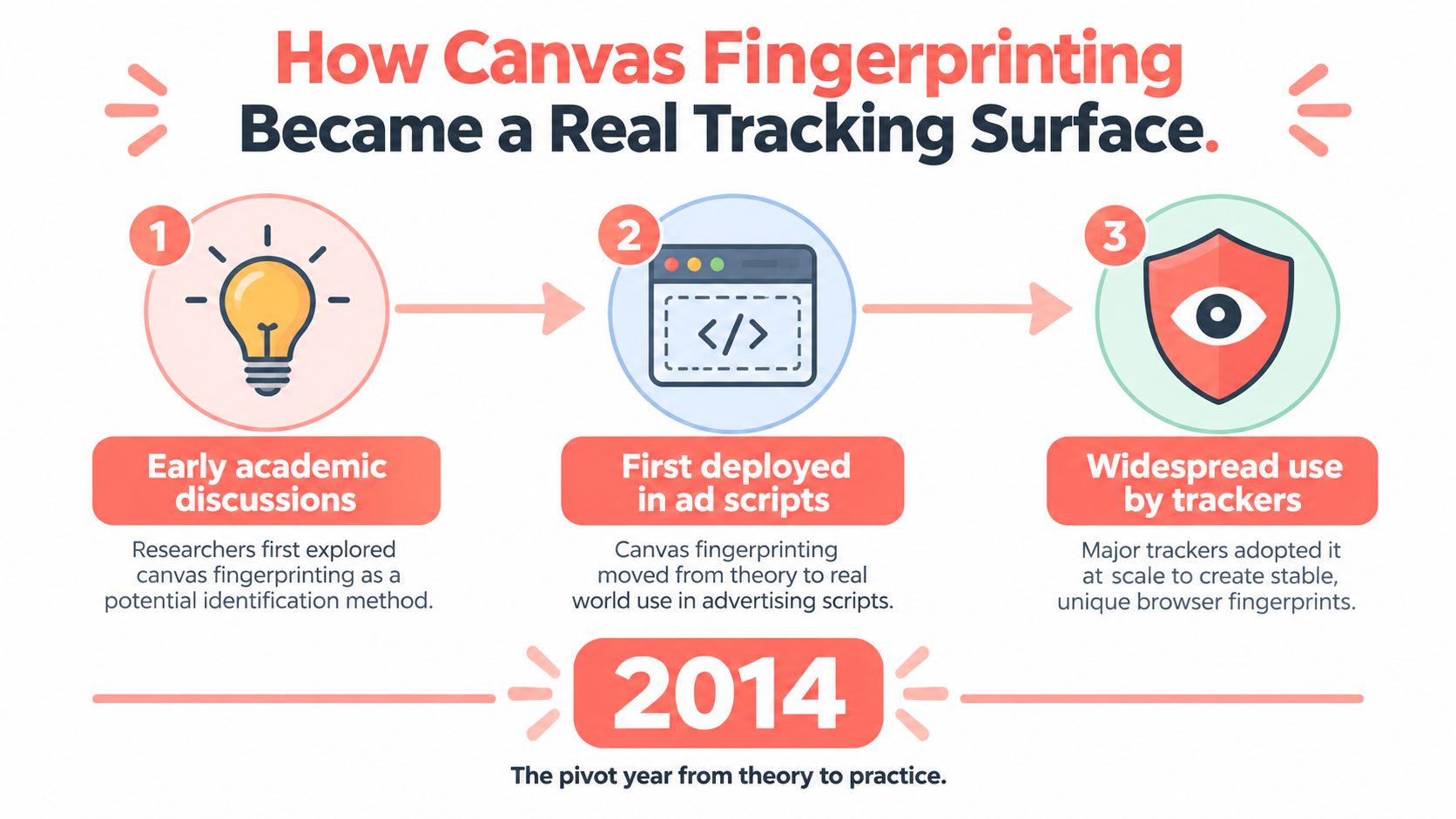
A rendering feature became an identity surface
The mechanism offered trackers a different persistence model from conventional cookies. Rather than retrieve an identifier previously stored in the browser, a script could derive an identifier from rendering output. Removing stored state therefore didn't necessarily remove the underlying distinguishing signal.
The concentration around AddThis matters more than a simple prevalence figure. Publishers didn't all need to develop graphics-based identification independently. A shared dependency could distribute the same measurement technique across otherwise unrelated websites.
That suggests a practical privacy priority: audit who gets to execute code, not just what your browser stores. If you operate a website, examine embedded analytics and advertising dependencies before treating fingerprinting exclusively as a visitor-side problem.
Operational insight: A cookie inventory and a script inventory answer different questions. You need both to understand who can observe a visitor.
Canvas belongs to a larger observation stack
For an automation engineer, canvas is a browser-side measurement, not a substitute for examining the connection. Keep network observations separate when diagnosing inconsistent identities. SiteAlive's network fingerprint tool is a useful resource to include in that separate network-layer investigation, rather than treating a canvas hash as a complete diagnostic.
The historical lesson is architectural. A useful feature became a tracking surface because its output reflected implementation differences, and shared infrastructure made collection economical.
That also explains why neutralizing it is difficult. The browser must still support legitimate rendering, while a defense must decide which observations to constrain. Removing an identifier is simpler than preserving a functional graphics API without exposing distinguishing behavior.
What the Browser Actually Does When You Read a Canvas
A canvas fingerprint starts with a controlled rendering challenge. A script supplies text, gradients, or geometric shapes, then examines the pixels the browser produces. The requested drawing may be identical across devices, but the implementation that executes it isn't.
The relevant differences include GPU hardware and drivers, browser graphics libraries, operating-system font rasterization, antialiasing, and hardware-acceleration paths, as explained in the technical account of persistent canvas tracking. Canvas doesn't need to expose a hardware serial number. It reveals the consequences of the rendering environment instead.
A creative canvas application uses the same underlying rendering capability that a fingerprinting script can measure.
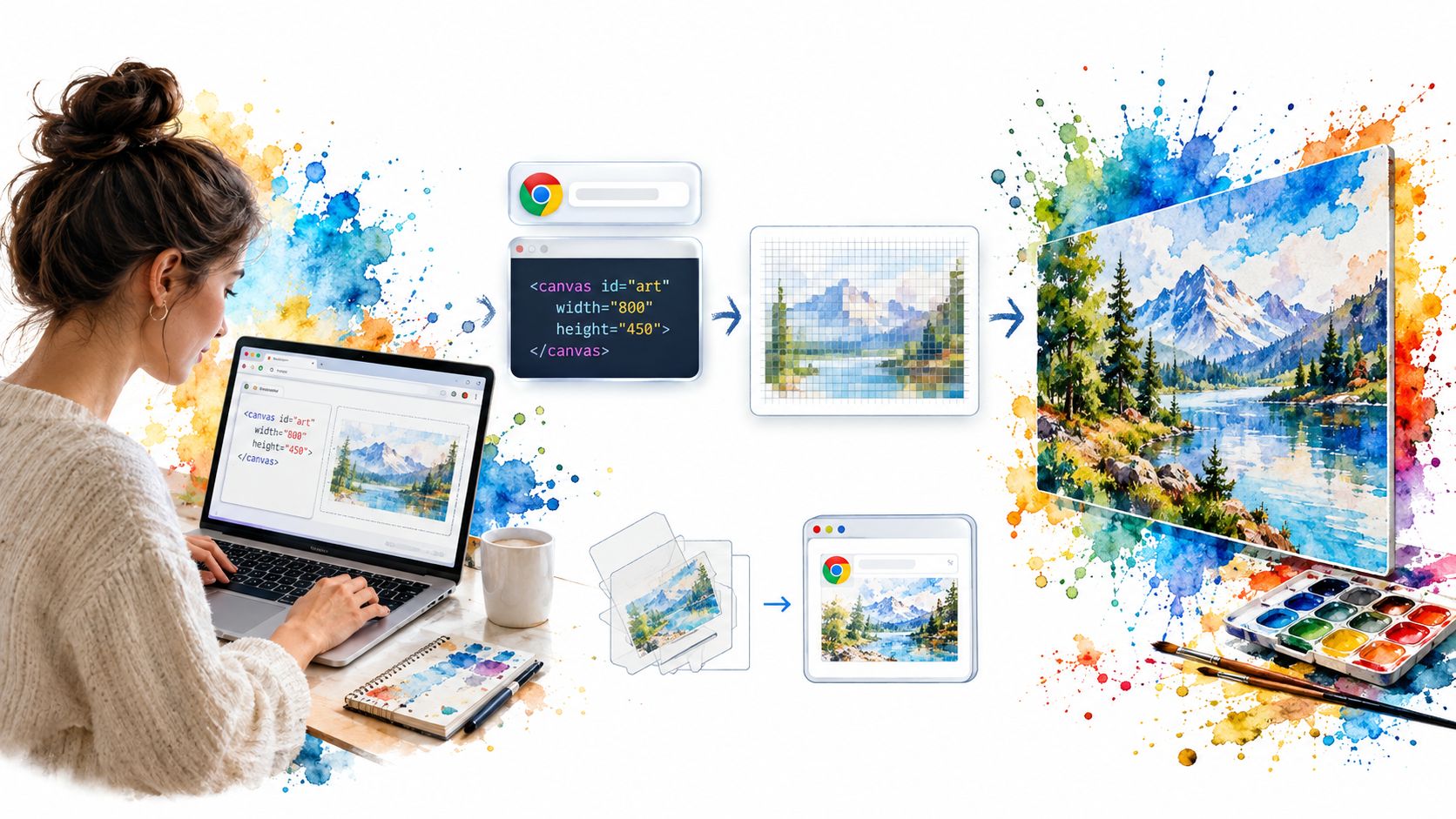
From drawing instructions to an identifier
Think of different printers producing subtly different versions of the same page. The document describes what should appear, but the printing machinery determines the exact edges, spacing, and color transitions. Canvas rendering has a comparable distinction between requested content and realized output.
A useful engineering decomposition is:
- Challenge construction: Choose content that exercises text rendering, blending, geometry, or other implementation-sensitive operations. A blank canvas tells you little about the rendering stack.
- Rendering: Let the browser resolve the drawing through its graphics and font environment. The observable result reflects the combined pipeline, not an isolated GPU property.
- Readback: Examine the result through interfaces such as
getImageDataortoDataURL. Pixel access and image serialization are related observation boundaries, but a test shouldn't assume they're interchangeable. - Reduction: Convert the observed output into a compact comparison value. Hashing makes comparison convenient; it doesn't create additional identifying information.
The hash hides the explanation
A changed hash only establishes that the compared outputs differ. It doesn't tell you whether the cause was a font change, a driver update, a different rendering mode, or an intentional defense.
For testing, retain enough information to investigate the difference. Compare rendered content and pixel changes alongside the final hash, and record the environment that produced them. Otherwise, an expected software update and an inconsistent patch can look identical in your dashboard.
The distinction between rendering and readback is especially important. A defense that modifies exported pixels may leave other observations untouched. Your test should therefore ask where the intervention occurs, which outputs it affects, and whether the browser behaves consistently when the same rendering challenge reaches another context.
A successful canvas test isn't merely evidence that a function returned a modified value. It's evidence about a specific path through the rendering stack.
Entropy and Stability of Canvas Fingerprints
Canvas output can narrow a population without uniquely identifying every member. In a Mechanical Turk experiment, 294 measurements produced 116 distinct fingerprint values, with reported sample entropy of 5.73 bits for combined 2D and 3D rendering and about 3.05 bits for the 2D-only component, according to the original canvas fingerprinting experiment.
These are sample results, not universal properties of Canvas. A different population, rendering challenge, or browser mix can produce different discrimination. Treating an experimental entropy value as an intrinsic specification of the API would be a category error.
The visual below illustrates the entropy-and-stability distinction. Its additional identifier comparisons and time-based stability annotation aren't established by the cited experiment and shouldn't be used as benchmark evidence.
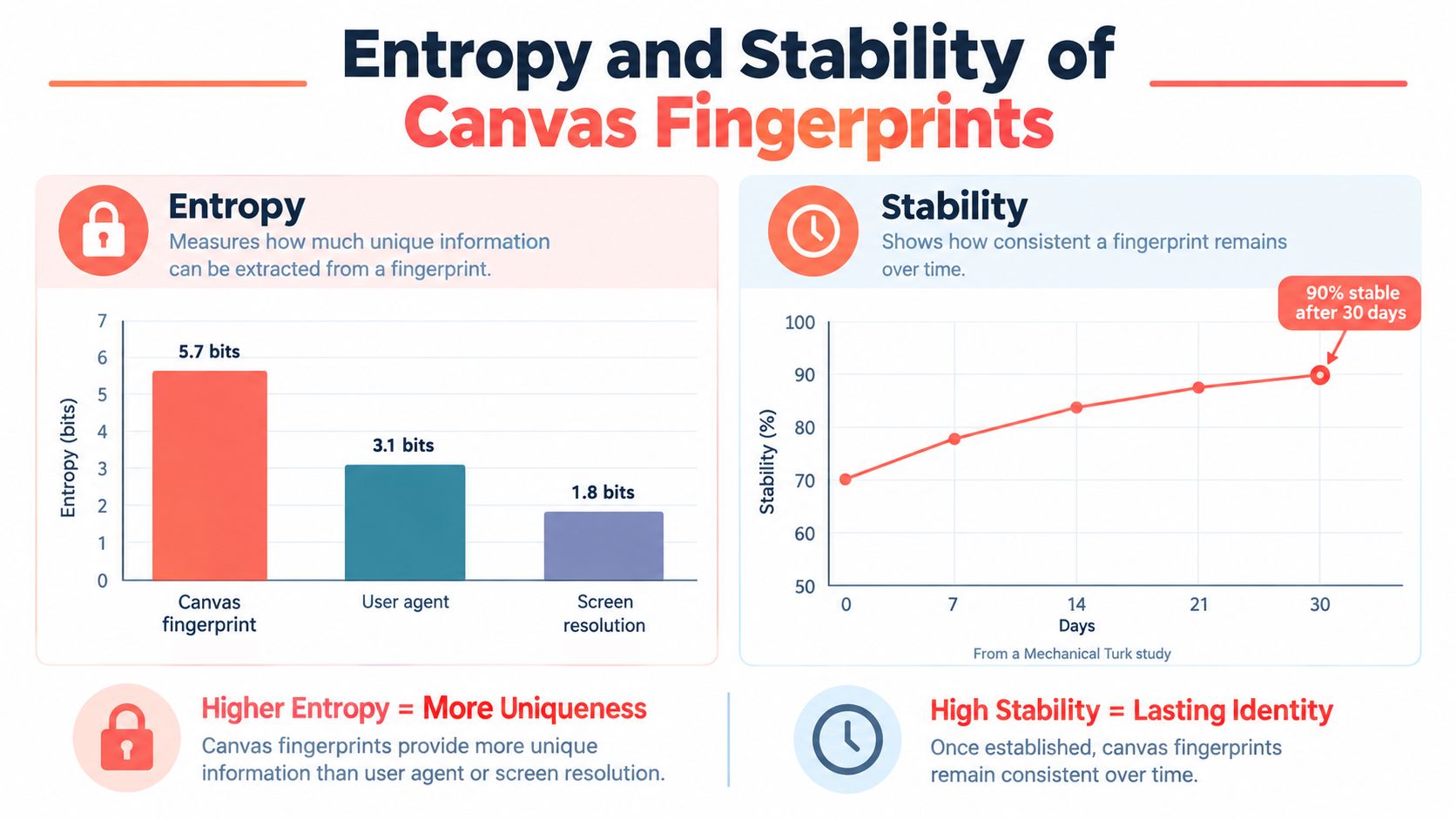
Discrimination isn't persistence
Entropy describes how much a measurement distinguishes observations in a population. Stability concerns whether an environment produces repeatable observations over time. A tracker needs useful discrimination and sufficient repeatability, not just an impressive collection of distinct hashes.
A highly variable measurement could separate visits while failing to connect visits from the same device. Conversely, an exceptionally stable value shared by many devices would contribute little discrimination. Neither property alone establishes a reliable identifier.
This also explains why adding browser signals doesn't justify adding their entropy values. Canvas, fonts, graphics capabilities, and browser version can reflect overlapping aspects of the same environment. My engineering conclusion is to treat them as correlated features, not independent identity tokens.
A fingerprint benchmark that reports uniqueness without repeatability measures only part of the problem.
Benchmark the changes you expect in production
For authorized QA, define which events should preserve an identity and which may legitimately change it. Browser restarts, repeated sessions, software upgrades, font changes, and GPU-driver changes deserve separate test cases.
- Hold the challenge constant: Otherwise, you can't distinguish environmental drift from a changed measurement procedure.
- Track repeatability: Preserve observations across restarts and sessions rather than comparing only different machines.
- Classify changes: Record planned environment updates separately from unexplained output changes.
- Inspect related attributes: Check whether a changed canvas result accompanies compatible changes elsewhere.
A browser fingerprinting tools workflow can organize these observations, but a diagnostic score isn't proof of anonymity. The useful deliverable is an explainable record of what stayed consistent, what changed, and whether those changes matched the intended environment.
The Coherence Problem Across Browser Realms
Consider a hypothetical test browser whose top-level page returns a controlled canvas result while an iframe exposes an untreated result for an equivalent challenge. The intervention worked where the engineer first tested it. The browser still presents conflicting observations.
That's the cross-realm coherence problem. The question isn't whether a patch exists, but whether every relevant observation path follows compatible identity rules.
The diagram maps the contexts that deserve investigation, not a guarantee that every context exposes identical graphics capabilities.
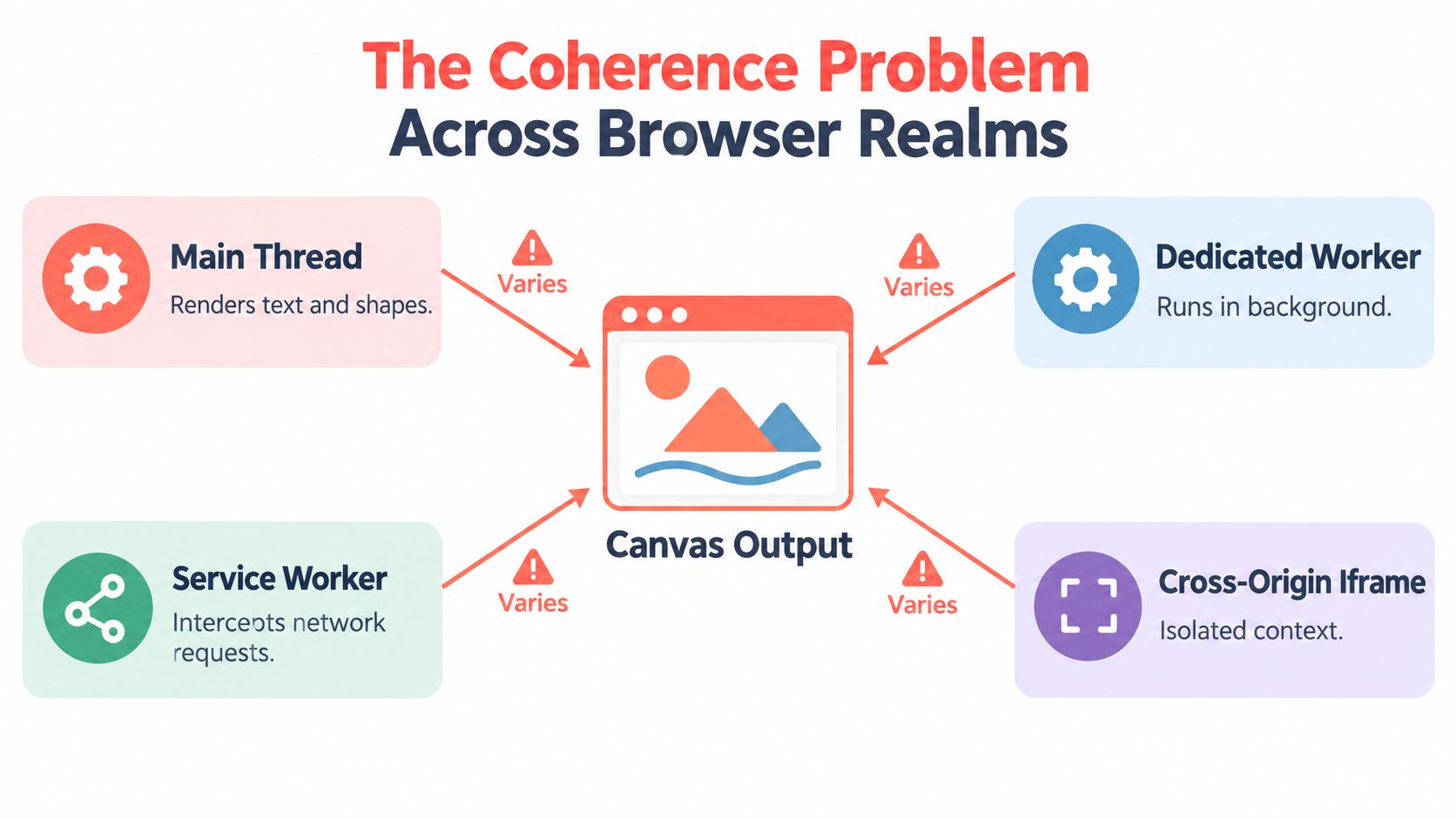
Equivalent challenges need compatible answers
The technical tracking research discussed earlier identifies a practical weakness in defenses confined to a JavaScript context: workers, iframes, or related graphics interfaces can expose inconsistent behavior. An engineering audit should translate that warning into comparisons rather than assume that successful main-page injection covers everything.
Coherence doesn't require identical output for unrelated operations. It requires answers that make sense together. Different rendering challenges should differ; equivalent challenges under equivalent conditions shouldn't disagree merely because a patch missed a context.
Test same-origin and cross-origin frames where applicable, and investigate worker-accessible rendering paths according to the browser's actual capabilities. Don't assume that dedicated workers and service workers offer interchangeable APIs. Capability differences belong in the test specification, not in a list of alleged leaks.
- Context coverage: Record where the controlled behavior applies and where native behavior remains.
- Observation coverage: Compare the supported readback paths rather than testing only a serialized image.
- Lifecycle coverage: Create fresh contexts and repeat measurements after navigation or restart.
- Failure behavior: Examine unsupported operations and errors as well as successful output.
Internal agreement extends beyond Canvas
The next question is whether the canvas behavior fits neighboring attributes. A hypothetical persona might present a particular graphics environment while its fonts or related rendering capabilities remain inconsistent with that configuration. A changed canvas hash wouldn't resolve that contradiction.
WebGL, WebGPU, AudioContext, fonts, and locale belong in the same audit, but agreement isn't sameness. Their relationships must be plausible, not mechanically identical. Likewise, a locale that differs from an exit location can be legitimate, so a mismatch deserves interpretation rather than an automatic verdict.
Use the accompanying video as an additional discussion aid, not as validation of any particular defense.
Watch the video on YouTubeThe important inference is that a fixed canvas isn't necessarily a coherent identity. A single-value test asks whether one output changed. A coherence audit asks whether an observer can distinguish your intervention by comparing outputs that should describe the same environment.
That distinction should determine your acceptance criteria before you choose an extension, injection library, or modified browser engine.
Why JavaScript Defenses Keep Falling Short
Advice to “block canvas” or “add random noise” skips the difficult part: what can an observer learn from the defense itself? Recent independent work evaluated 18 extensions and built-in protections across Chrome, Firefox, Brave, Tor, and Safari and concluded that no fully deployable defense currently exists, according to the academic evaluation of canvas fingerprinting defenses.
That conclusion covers the evaluated protection options. It shouldn't be rewritten as proof that every JavaScript intervention is useless, or that engine-level modifications automatically succeed. The relevant finding is that protection, detectability, and practical deployment remain difficult to satisfy together.
Audit what the defense changes
Common strategies deserve different tests. They aren't interchangeable privacy settings.
| Strategy | Intended effect | Question to test |
|---|---|---|
| Fixed output | Remove environment-dependent variation | Does the response look altered or conflict with another observation? |
| Randomized output | Disrupt repeatable identification | Can repeated measurements reveal the intervention? |
| Blocked readback | Prevent extraction | Which legitimate workflows stop functioning? |
| Selective modification | Preserve functionality while changing identifying output | Are unmodified paths still observable? |
The research identifies the central paradox: randomization can become a detectable signal. Altered or fixed rendering can also expose inconsistencies across contexts. A defense can reduce information about the underlying device while revealing information about the protection configuration.
That doesn't make every detectable defense less private. Detectability and linkability are different outcomes. The engineering mistake is to measure neither and assume that modified pixels establish success.
Acceptance criterion: Test whether the intervention reduces unwanted identification without introducing an unexplained, repeatable signature of its own.
Compatibility is part of deployability
Blocking canvas reads can interfere with legitimate graphics, games, design applications, accessibility tools, and anti-fraud workflows. The appropriate tolerance depends on the user's objective. A research browser can accept restrictions that a production QA environment can't.
For Playwright users, a stealth-mode assessment should include context coverage and compatibility, not just whether a demonstration page displays a favorable verdict. Passing one detector is evidence about that detector under those conditions.
A more useful evaluation separates outcomes:
- Data reduction: What information does the observer no longer receive?
- Defense exposure: What new evidence identifies the modification?
- Application compatibility: Which tasks fail, and can the team accept those failures?
- Operational repeatability: Does the configuration behave as intended across fresh sessions and context creation?
My conclusion is narrower than “JavaScript defenses don't work.” JavaScript-level success is often local unless demonstrated otherwise. Engineers should demand evidence that an intervention remains coherent outside its initial injection target and under the lifecycle their application uses.
Engine-Level Controls and How Clearcote Approaches Coherence
Engine-level controls change where an identity policy is implemented. Instead of replacing an exposed JavaScript function in a particular context, an implementation can modify the browser code responsible for producing or returning the relevant values.
Clearcote describes its Canvas, WebGL, WebGPU, AudioContext, font, and locale controls as implemented in C++ paths rather than injected JavaScript. Its proxy geo-matching adjusts timezone, languages, and WebRTC to the exit IP. Those are architectural claims about control placement and configuration, not evidence of universal undetectability.
Engine-Level vs JavaScript-Level Fingerprint Controls
| Dimension | JS-level defenses | Engine-level (Clearcote) |
|---|---|---|
| Control placement | Modify exposed behavior in targeted contexts | Sets identity signals in C++ paths |
| Realm coverage | Depends on injection coverage and timing | Describes shared engine controls for main thread, workers, and iframes |
| Graphics consistency | Requires coordination with untreated rendering behavior | Offers a real-GPU canvas bridge for persona alignment |
| Identity persistence | Depends on the implementation's state policy | Uses seeded identities for repeatable configurations |
| Geographic configuration | Requires separate coordination | Automatically adjusts timezone, languages, and WebRTC to the proxy exit |
| Verification | Inspect scripts and observed behavior | Inspect patches, builds, and observed behavior |
The architectural advantage is that engineers can place a policy below multiple observation boundaries. The limitation is equally important: lower placement doesn't prove complete coverage. An omitted path, incompatible rendering choice, or unusual output relationship can still undermine the intended identity.
Separate product mechanisms from validated outcomes
Clearcote's published approach includes seeded identities, a real-GPU canvas bridge, network-stack alignment with the presented browser version, and reproducible, checksummed, signed open builds. Each mechanism addresses a different concern. None should stand in for an independent measurement of the full configuration.
For example, a deterministic seed supports repeatable QA, but repeatability alone doesn't establish unlinkability. A GPU bridge aims to align rendered pixels with a claimed graphics profile, but engineers still need to compare supported challenges and related capabilities.
Likewise, readable patches and verifiable builds make implementation review more practical. They don't establish that every returned persona belongs to a common population or that a targeted observer can't recognize it.
- Inspect the implementation: Identify which rendering and readback paths the controls change.
- Validate the persona: Compare cross-realm behavior and related identity attributes under the intended configuration.
- Repeat after updates: Re-run the same acceptance tests when the browser or profile changes.
For deployment, distinguish identity engineering from hosting. A cloud-browser deployment can change who maintains the runtime, but it doesn't remove the need for evidence.
Engine-level controls are therefore a credible architectural option alongside browser protections and extensions. Whether they solve your coherence problem remains a testable proposition, not a consequence of the phrase “engine-level.”
Choosing the Right Defense by Threat Model
Choose the observer and the harm before choosing the intervention. Ciphar's threat model guide provides a useful starting point for making those assumptions explicit.
- Casual analytics: Prioritize limiting unnecessary third-party execution. Browser protections may be adequate if their compatibility trade-offs fit your browsing.
- Cross-site identification: Evaluate linkability across sessions and sites, not just changes to a local canvas hash.
- Authorized anti-fraud and bot-detection testing: Prefer explainable, reproducible configurations. A stable persona is useful for isolating test variables, though stability isn't a privacy guarantee.
- Targeted identification: Don't treat canvas controls as an anonymity system. Broaden the assessment beyond rendering.
For Playwright or Puppeteer QA, reuse profiles when reproducibility is the requirement and document when identity changes are intentional. Compare hosted residential-IP browsers with a local fleet on maintenance, network requirements, and test control rather than assuming either deployment is more private.
Coherence is worth engineering when contradictory observations threaten your actual workflow. It isn't a substitute for defining that workflow.
Clearcote Labs offers engine-level browser identity controls and local or hosted options for Playwright and Puppeteer workflows. Visit Clearcote Labs to examine its implementation and run a cross-realm canvas audit against your existing browser configuration before deciding whether its controls meet your requirements.