The most popular advice on Playwright alternatives is also the least useful. Pick the fastest framework, or the one with the most downloads, and your flaky suite will supposedly fix itself. It won't. A framework swap moves your maintenance work, it doesn't automatically reduce it, and it can't repair unstable test data, shared state, or a browser identity that changes between runs.
Playwright is an excellent default for modern cross-browser end-to-end tests. The strongest alternative depends on the automation job. A mature WebDriver stack fits an established polyglot suite. A lean JavaScript library fits scraping and scripting. An AI oriented SDK fits unpredictable tasks where fixed selectors would constantly break.
Start with the failure mode you need to solve. That's protocol portability, test diagnosis, direct browser control, distributed execution, AI agents, or repeatable identity. Teams evaluating adjacent tooling in other categories can also find better enrichment providers, but for browsers, the job matters more than popularity.
Some tools below replace Playwright. Others, especially browser runtimes and SDK layers, work alongside Playwright or Puppeteer. Don't confuse those categories, because you'll otherwise rewrite tests when you only needed to change the browser underneath them.
Table of Contents
- 1. Clearcote Labs
- 2. Puppeteer
- 3. Selenium
- 4. Cypress
- 5. WebdriverIO
- 6. Stagehand
- 7. Browser Use
- Top 7 Playwright Alternatives Compared
- Choose by Constraints, Then Validate with a Small Pilot
1. Clearcote Labs
Clearcote Labs belongs in a different lane from test frameworks: a de-Googled Chromium build for automation, privacy research, and repeatable identity. Choose it when Playwright code is stable but the browser underneath returns mismatched signals between runs.
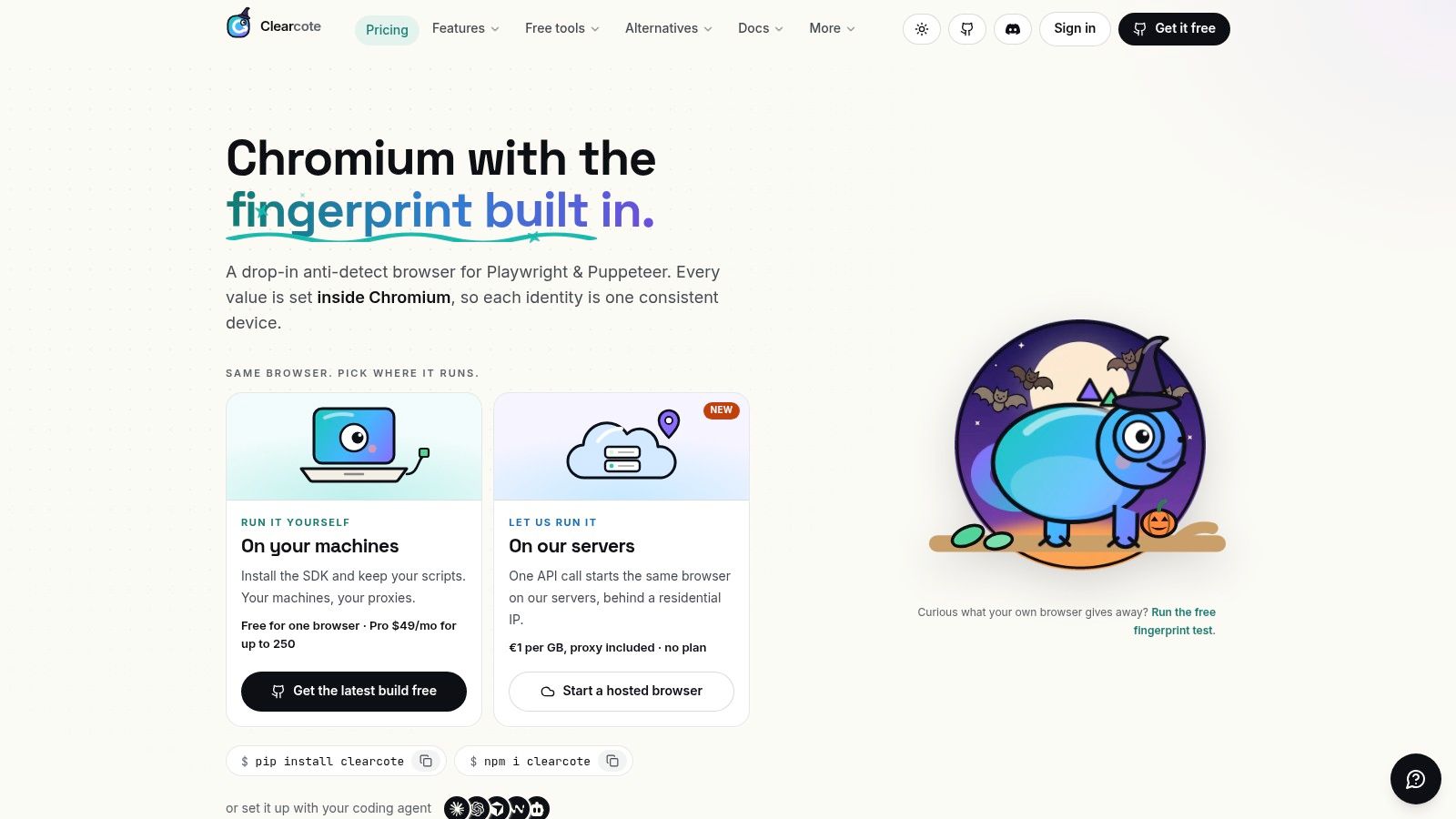
The control point is engine level rather than injected page scripts. Canvas, WebGL, audio, font, and hardware values are set inside Chromium so pages, workers, and iframes agree with each other. Seeded identities can persist across sessions, TLS and HTTP/2 settings can match the presented Chrome version, and proxy geolocation can carry timezone, language, and WebRTC into the same profile.
Compatibility still decides whether this is useful. This analysis of Selenium alternatives and browser compatibility requirements notes that Playwright suits modern parallel suites while Selenium remains valuable for legacy test farms and multi-language CI; for Clearcote, the practical requirement is preserving CDP and standard WebDriver attachment so existing drivers can connect.
How It Fits Existing Workflows
Clearcote can run under Playwright or Puppeteer through Python, Node.js, and .NET SDKs, with Docker, CDP, an MCP server, and a no-code Profile Manager as entry points. That makes it closer to browser infrastructure than a framework replacement: the suite keeps its selectors, waits, and assertions while the runtime becomes controlled.
- Engine-level coherence: Identity signals stay consistent across pages, workers, and iframes.
- Repeatable personas: Seeded identities and captured device profiles support persistent QA scenarios.
- Flexible deployment: Run locally, in Docker, or on hosted browsers with residential proxies included.
- Verifiable releases: Builds are checksummed and GPG-signed, and the open build is reproducible.
Practical rule: When diagnosis points away from flaky assertions and toward inconsistent browser identity, test the runtime before funding a rewrite.
Packaging splits by control and scale. The reproducible BSD-3-Clause open build is free, the latest licensed build is free for one concurrent browser with an eligible GitHub account, and Pro targets larger concurrency. Hosted use is billed per gigabyte with proxy included.
The trade-offs are real. The latest licensed build is not fully reproducible from public source, and the open build may trail new Chromium releases. Fingerprint coherence also does not guarantee a site will accept automation, so lawful purpose and disciplined workflow design still matter. Visit the Clearcote Labs site to test the free open build against one representative workflow before committing to a framework rewrite.
2. Puppeteer
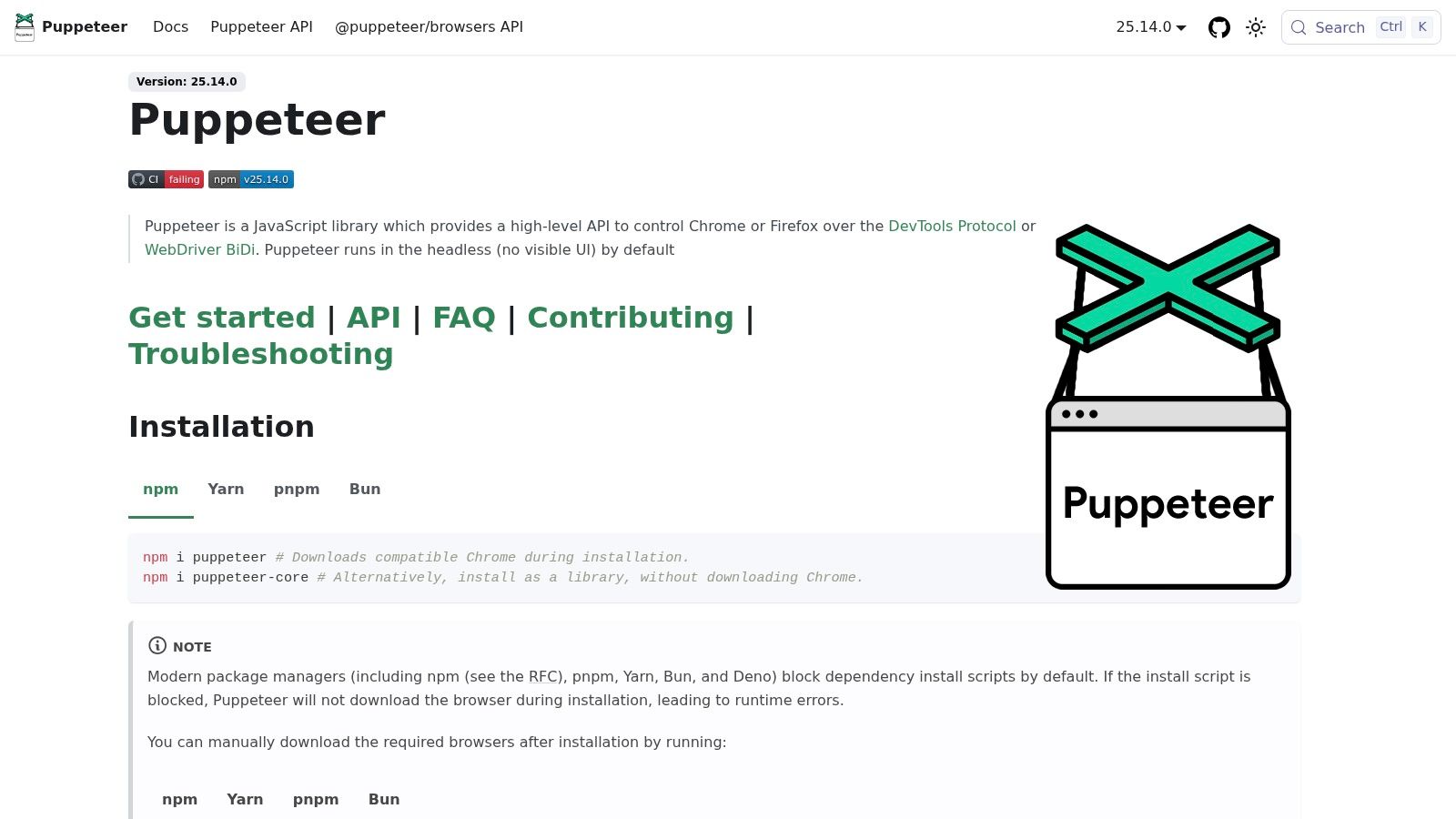
Puppeteer is the right alternative when you don't need a test framework. It's a JavaScript library for code-first browser control, especially in Chromium oriented workflows like scraping, screenshots, PDF generation, and custom browser scripting. Teams often shortlist it against Playwright, then discover they're comparing a library with a complete test system.
Google released Puppeteer in May 2017 as a Node.js library built around the Chrome DevTools Protocol, while Microsoft backed Playwright followed in November 2019 targeting Chromium, Firefox, and WebKit, according to Selenium's 2021 global user survey results. That survey also found 78% of respondents tested with multiple browsers, a reminder that Chromium first tooling doesn't cover every QA requirement.
Where Puppeteer Earns Its Place
Puppeteer supports Chrome and Firefox, runs headless by default with a visible browser option, and can connect to existing or remote browser instances. Its JavaScript and TypeScript API feels direct because you're close to the browser, not negotiating with a runner's conventions. For containerized setups, this guide to running Puppeteer in Docker covers the practical deployment path.
- Direct API: Familiar, low ceremony control for browser scripting.
- Chromium strength: A strong fit for Chrome focused automation and scraping.
- No license cost: Free and open source.
The cost shows up when you need a suite. There's no built-in test runner, assertions, fixtures, or parallel reporting model comparable to Playwright Test, so your team assembles those pieces. Browser installation and management also become part of your setup.
Choose Puppeteer for a browser automation service or script. Don't choose it to replace a mature cross-browser end-to-end suite unless you're prepared to rebuild the surrounding framework.
3. Selenium
Selenium looks old next to Playwright, and that's precisely its advantage in the right organization. It originated at ThoughtWorks in 2004, Selenium and WebDriver merged into Selenium 2.0 in July 2011, and the protocol became a W3C Recommendation in 2018, as Chrome's history of test automation evolution documents. You're buying standardization and ecosystem depth, not novelty.
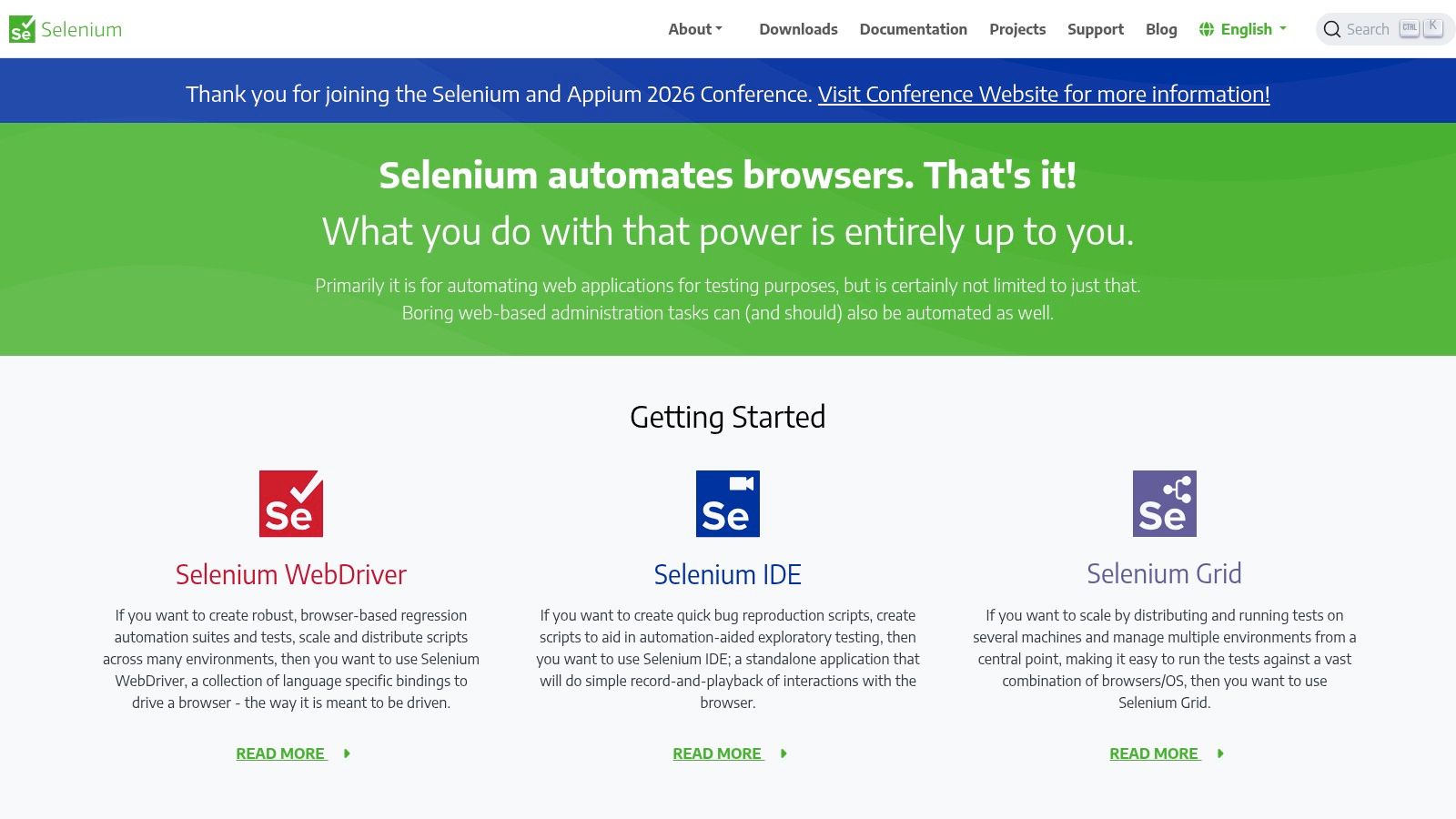
Selenium provides WebDriver bindings for multiple programming languages, including Java, Python, C#, JavaScript, Ruby, and Kotlin. It supports Chrome, Edge, Firefox, Safari, and other browser backends. Selenium Grid distributes execution across machines and environments, while Selenium IDE offers basic record and playback.
That breadth suits teams with existing language diverse QA infrastructure, centralized grids, and vendor neutral browser requirements. If your organization already owns page objects, driver management, and CI integrations, migrating away may cost more than modernizing in place. The detailed Selenium versus Playwright comparison is useful when that boundary isn't obvious.
The Infrastructure Bill
- Broad ecosystem: Wide language and browser support for established suites.
- Grid scaling: Distributed execution across environments you control or rent.
- Driver coordination: Setup can require installing and aligning browser drivers.
- Missing batteries: Test runners, reporting, and waiting strategies often need additional components.
Selenium automates browsers and leaves the framework around them to you. That's freedom for a disciplined platform team and overhead for everyone else.
Pick Selenium when protocol portability, legacy compatibility, or an existing Grid dominates. For a new JavaScript heavy project with no legacy constraints, Playwright usually gives you a faster start.
4. Cypress
Cypress wins when the bottleneck isn't writing tests, it's understanding why one failed. It's primarily a web application testing framework for applications your team develops, with an open source app for end-to-end and component testing. Its local runner creates a tight debugging loop for frontend developers.
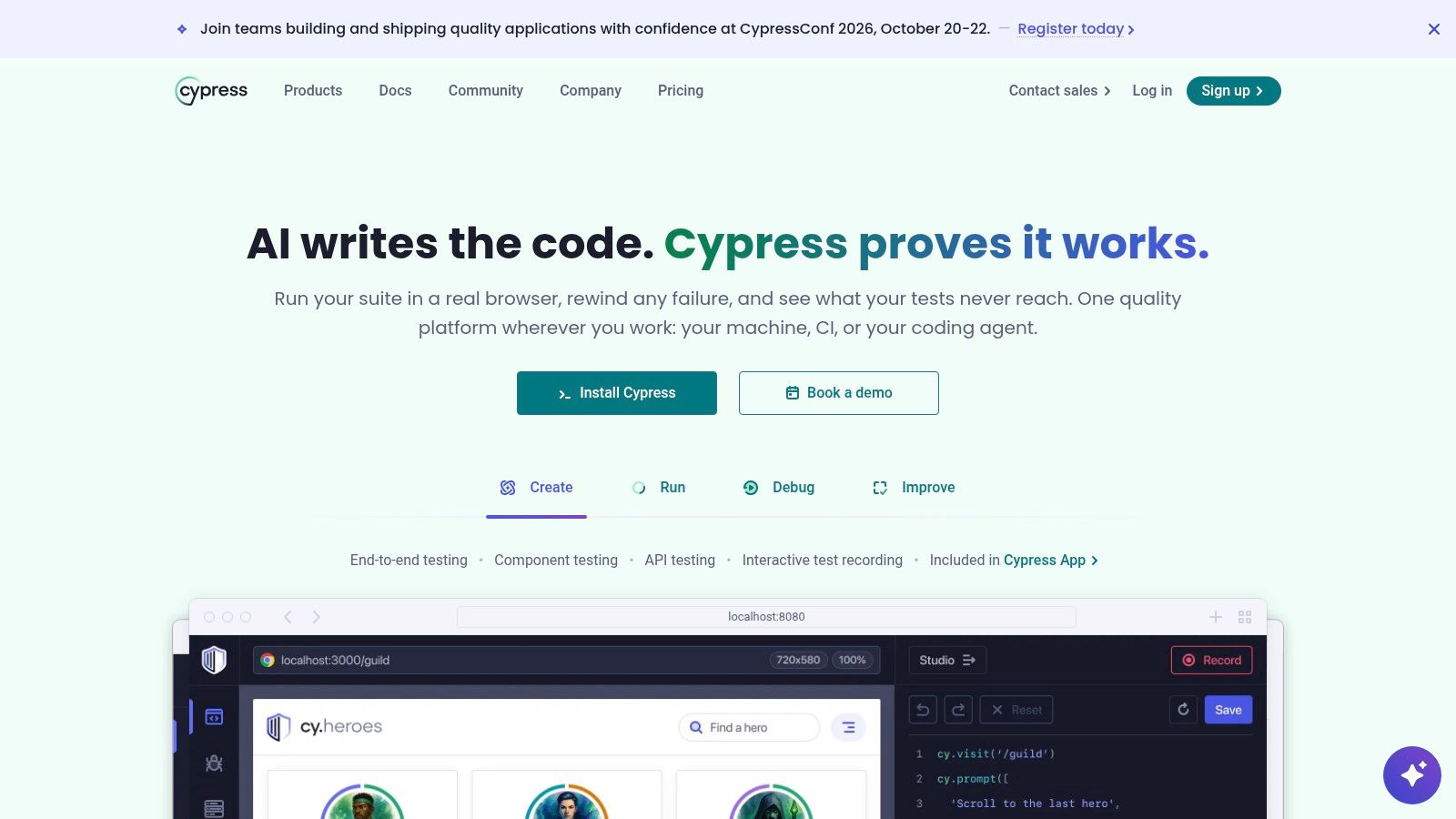
Cypress is technically distinct rather than a drop-in Playwright replacement. It runs closely within the browser's execution model and is optimized for frontend teams testing applications they control, a point made in this practitioner comparison of Playwright and Cypress. That comparison reports approximately 6 million weekly npm downloads for Cypress and estimates Playwright near 33 million, figures that signal momentum but don't equal unique users or organizational market share.
What You Gain and Give Up
The local test runner and debugging workflow help you investigate failures where they happen. Optional Cypress Cloud adds run recording, replay, orchestration, and analytics for teams that need shared visibility. The core app is free and MIT licensed for macOS, Linux, and Windows.
- Component testing: Strong fit when components are tested in a real browser.
- Failure diagnosis: A testing focused workflow built around local feedback.
- Specialized scope: Less suited to general purpose browser automation and scraping.
- Cloud cost: Team recording and orchestration features may add paid services.
Its architecture is also less suitable for cross-origin navigation, multiple tabs, or broad external site automation. Those aren't edge cases if you're automating third party flows, they're the job itself.
Choose Cypress for JavaScript and TypeScript teams testing first party applications. Favor Playwright or Selenium when cross-browser breadth, multi-context workflows, persistent sessions, or external domain automation are core requirements.
5. WebdriverIO
WebdriverIO is the alternative for teams that want Playwright style JavaScript ergonomics without giving up the WebDriver ecosystem. It's a JavaScript automation framework supporting WebDriver and WebDriver BiDi, plus additional protocol bindings and integrations. You can use it for runner based browser testing or standalone automation.
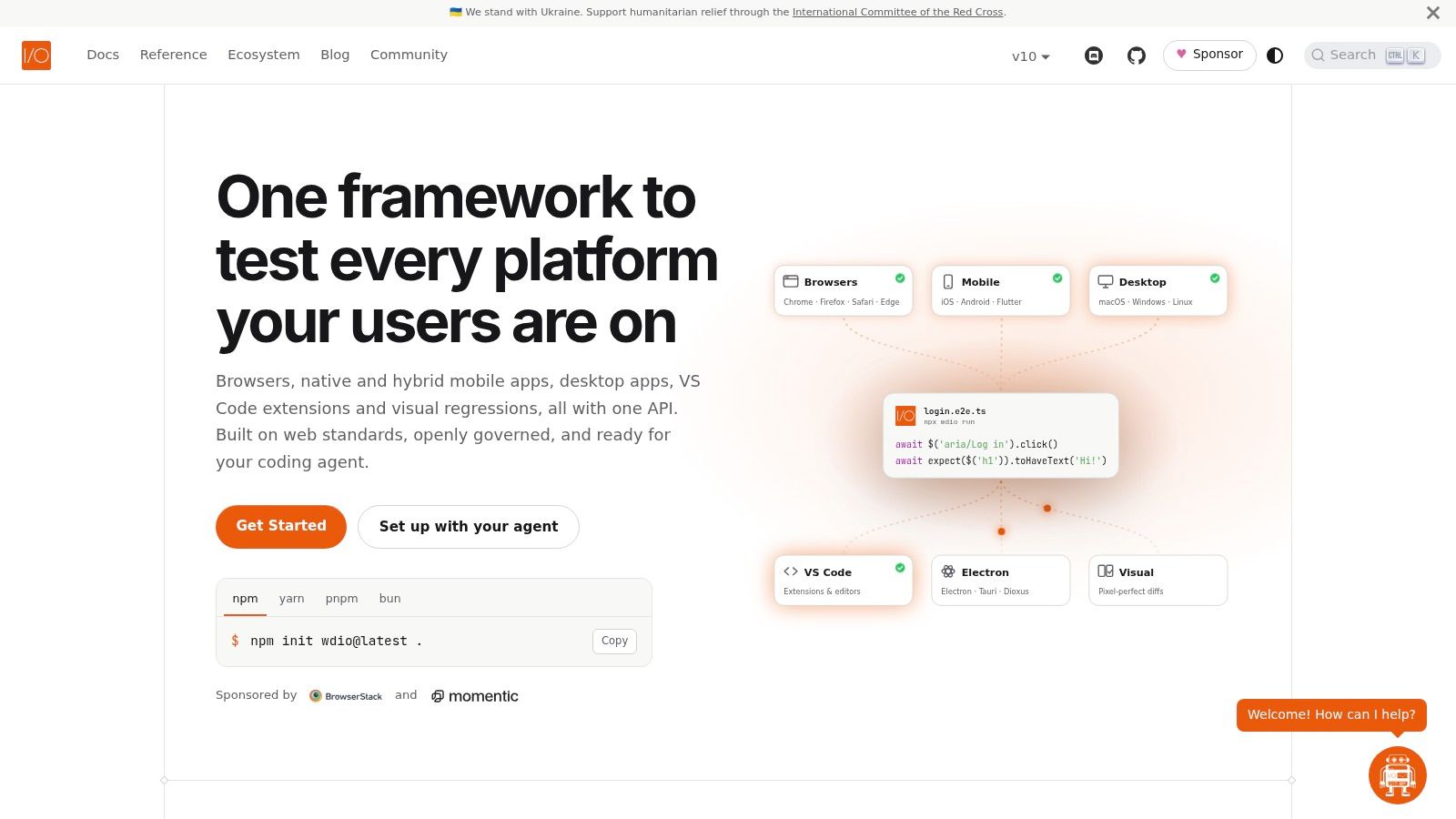
The strategic question here is protocol direction, not just API taste. Mozilla recorded WebDriver BiDi Milestone 17 as completed on September 26, 2025, while noting Playwright's experimental BiDi support still needed capabilities such as user context configuration and geolocation emulation, according to Mozilla's WebDriver BiDi milestone tracking. Standardization, however, doesn't automatically deliver parity with Playwright fixtures, tracing, or emulation.
Flexibility With Configuration Attached
A setup wizard helps configure projects for web, mobile, desktop, or extension testing. WebdriverIO supports standalone Node.js scripts as well as full test suites, which makes it useful when browser testing sits inside a wider automation setup. Its integration ecosystem is substantial.
- Dual protocol path: WebDriver today with a BiDi direction for standards oriented teams.
- Broad targets: Workflows beyond conventional web pages, including mobile and desktop contexts.
- Configuration burden: Requires Node.js and deliberate framework choices.
- Migration checks: Verify your exact protocol and browser combination before committing.
Analyst view: BiDi reduces vendor dependence over time, but you should pilot feature completeness today rather than buying a roadmap.
WebdriverIO suits teams that need one JavaScript framework across several automation targets and have someone willing to own configuration. If you only need straightforward web end-to-end tests, that flexibility can become unnecessary surface area.
6. Stagehand
Stagehand answers a different question from the tools above. What happens when the page structure is unpredictable and writing a precise selector for every step becomes the fragile part? It's an open source SDK for browser automation and AI agents that mixes conventional code with model directed actions.
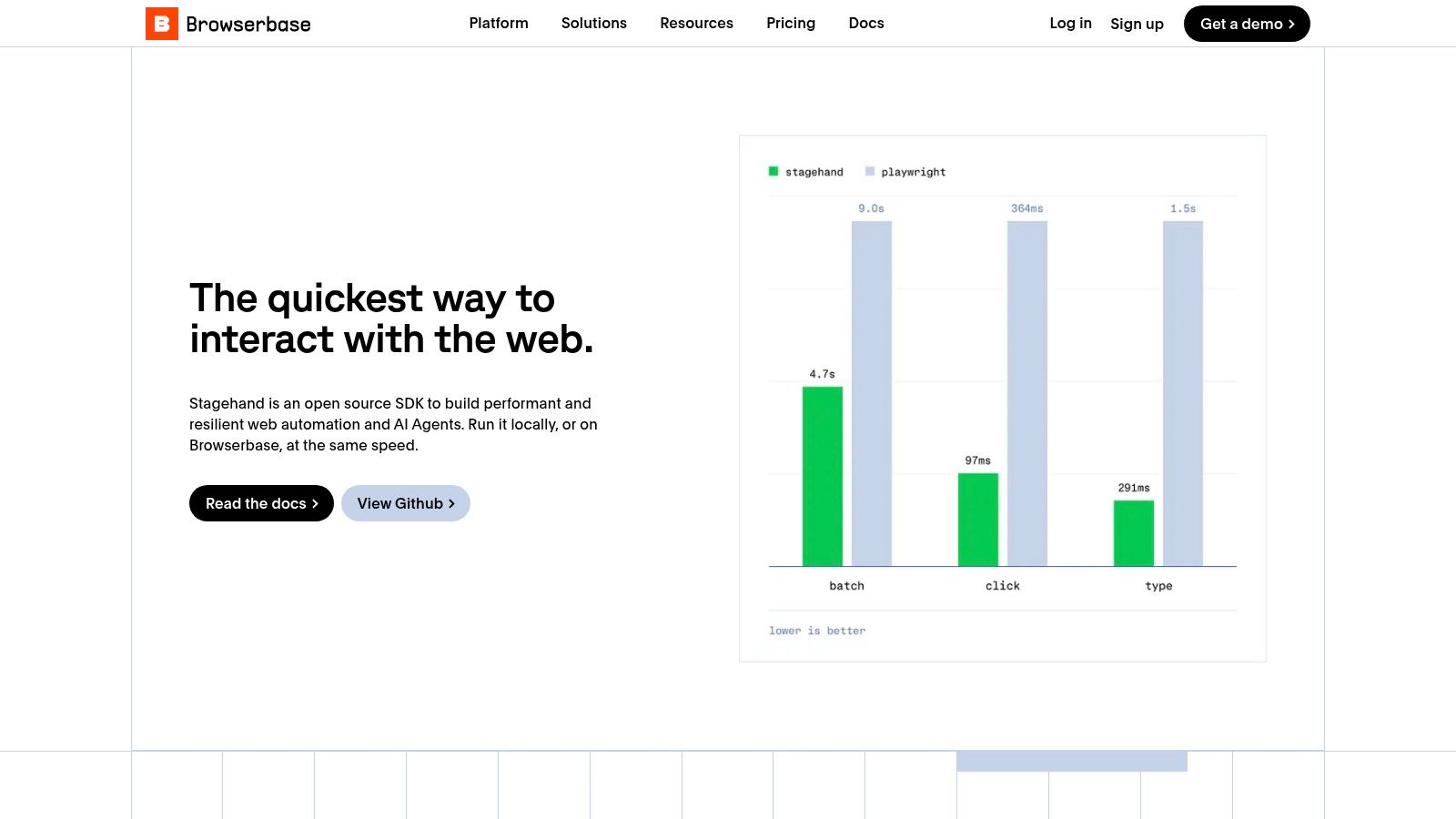
Stagehand combines a Playwright style page API with natural language oriented act(), extract(), and observe() primitives. Developers can keep deterministic code for known steps and delegate ambiguous actions or extraction to a model. That hybrid design is more credible than handing the entire workflow to an agent without guardrails, a theme explored in this overview of AI browser agents.
Running It Your Way
The SDK supports TypeScript, Python, and Go, is free and MIT licensed, and can run with local Chromium. Browserbase hosting is optional for managed browser sessions. Local use therefore doesn't require Browserbase infrastructure, though production scale may change that calculation.
- Hybrid control: Combine AI directed actions with explicit browser code.
- Extraction primitives: Useful when output structure matters as much as navigation.
- Model considerations: Model selection, behavior, and cost become operational variables.
- Hosted charges: Managed production use may add Browserbase and model fees.
Stagehand isn't a drop-in replacement for every Playwright test suite. Deterministic regression tests should stay deterministic where the application is under your control. Use model directed steps where pages vary, instructions are naturally expressed in language, or extraction targets shift.
Evaluate it with tasks that include ambiguity, retries, and wrong turns, not just a clean login demo. Agent quality shows up in recovery behavior and total model cost per successful task.
7. Browser Use
Browser Use sits furthest from a conventional test runner on this list. It offers an open source Python library for AI browser agents, plus hosted agents and browser infrastructure. If your goal is submitting a multi-step task in natural language and receiving a result, that's the category you're in.
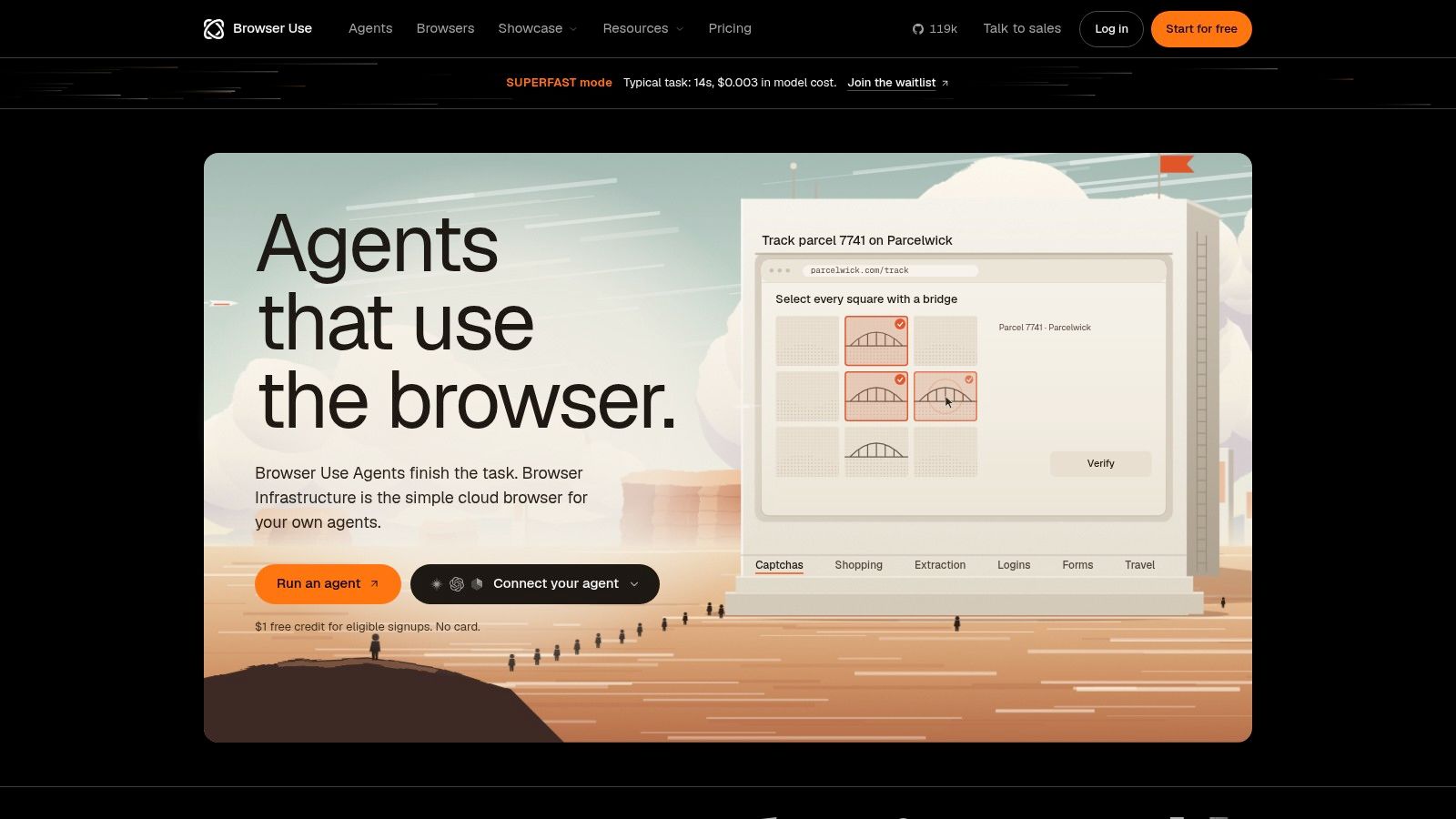
The MIT licensed library can use local or remote browsers, and you can self host agent code with different model providers. Hosted options include Browser Use Cloud, a hosted agent service, and browser infrastructure with proxy and CAPTCHA related features. That infrastructure can also complement Playwright or Puppeteer rather than replacing them outright.
Agent First, Not Test First
- Local or hosted choice: Run your own agent code or buy managed execution.
- Task orientation: Built for natural language, multi-step browser work.
- Predictability trade-off: Agent behavior can vary more than explicit scripts.
- Usage dependent cost: Cloud browser, proxy, and model charges can accumulate.
Don't judge an agent framework by whether it can click a known button. Judge it by how it handles an unexpected modal, a missing result, and a task that should stop instead of improvise.
Browser Use suits developers building task oriented agents, research workflows, and exploratory automation where the path can't be fully specified in advance. It isn't a conventional end-to-end testing framework, and using it as one would trade repeatable assertions for probabilistic execution.
For Python teams, the decision is whether autonomy is worth added variance and monitoring. Put budgets, step limits, logging, and human review points around agents before they touch production data or external accounts.
Top 7 Playwright Alternatives Compared
| Tool | 🔄 Implementation complexity | ⚡ Resource requirements and cost | 📊 Expected outcomes | Ideal use cases | ⭐ Key advantage |
|---|---|---|---|---|---|
| Clearcote Labs | Moderate; integrates with Playwright/Puppeteer or runs via Docker, CDP, MCP, or Profile Manager | Free open build; licensed options; hosted use is €1/GB with proxy included | Consistent, configurable browser identity signals; fingerprint consistency does not guarantee avoidance of detection | Repeatable browser testing, privacy research, automation needing persistent identities or proxy geolocation | Engine-level fingerprint controls and flexible deployment |
| Puppeteer | Low to moderate; JavaScript/TypeScript-focused, with browser setup potentially required | Free and open source; browser installation or management may be needed | Direct browser scripting and automation, especially with Chrome | Chrome-focused automation, scripting, and scraping | Familiar, code-first API |
| Selenium | Moderate to high; driver setup and coordination may be needed | Free and open source; Grid can require additional infrastructure | Cross-browser, distributed WebDriver test execution | Established test suites, multi-language teams, and cross-browser testing | Broad language and browser support |
| Cypress | Low to moderate; integrated testing workflow, with optional Cloud setup | Core app is free and MIT-licensed; Cloud and premium features may cost extra | End-to-end and component tests with debugging and optional run management | Testing web applications developed by your team | Testing-focused debugging workflow |
| WebdriverIO | Moderate; Node.js and framework configuration required | Open-source framework; infrastructure depends on browser and test setup | Browser automation and testing across supported protocols and platforms | Teams combining web testing with mobile, desktop, or extension automation | Flexible protocols and integration ecosystem |
| Stagehand | Moderate; requires SDK setup and, for AI actions, model configuration | Open-source SDK; model and optional Browserbase hosting may add costs | Mixes conventional browser control with natural-language-driven actions | AI browser agents that combine code with model-directed tasks | AI-oriented actions alongside a Playwright-style API |
| Browser Use | Moderate; Python setup and agent/model configuration required | Open-source library; hosted browsers, proxies, and models may incur usage-based costs | Natural-language agents can complete multi-step browser tasks; behavior may be less predictable than scripts | Task-oriented browser agents and hosted browser workflows | Local or hosted agent options with multiple model-provider choices |
Choose by Constraints, Then Validate with a Small Pilot
There's no universal winner among these Playwright alternatives. Use Selenium or WebdriverIO when protocol portability and distributed browser infrastructure dominate. Choose Cypress for application focused end-to-end and component testing, and use Puppeteer for direct JavaScript browser control.
Evaluate Stagehand or Browser Use when natural language agent behavior is central. If persistent identity coherence, browser fingerprints, proxy alignment, or repeatable browser personas are the constraint, Clearcote Labs is a complementary browser layer rather than a reason to rewrite every Playwright test.
The neglected question isn't which alternative is fastest. It's whether switching reduces flaky test maintenance. One comparison reported that 73% of surveyed QA engineers identified flaky tests as the primary factor reducing trust in their automation suite, while reporting Playwright usage at 45.1% versus Selenium at 44%, according to AgamiSoft's Playwright versus Selenium comparison. Popularity doesn't establish reliability.
Replacing Playwright may leave dominant cost drivers untouched if failures come from unstable environments, poor test data, network dependencies, or inadequate isolation. In that case, don't migrate. Fix the suite design first, using clear guidance on how to create test cases that separate product defects from infrastructure and synchronization failures.
A Pilot That Produces Evidence
- Define the baseline: Record current flake rate, reruns, and time to diagnosis.
- Run identical workflows: Use the same browsers, CI workers, data, and test cases across shortlisted tools.
- Measure operating cost: Include infrastructure, model charges, proxy needs, and staff time.
- Test identity separately: Check whether the browser runtime, not the framework, causes inconsistent sessions.
A hybrid architecture is often the honest answer. Retain Playwright for cross-browser end-to-end tests, add Puppeteer for a narrow Chromium job, or keep Selenium for a legacy grid while new work uses a different stack. That isn't indecision, it's matching tools to jobs.
Pick the combination your team can still understand, debug, and afford after the migration excitement fades. The pilot data, not a feature checklist, should make the final call.
If browser identity is the constraint behind your automation problems, try Clearcote as a drop-in Chromium runtime for your existing Playwright or Puppeteer scripts, with seeded personas, engine-level fingerprint controls, and local, Docker, or hosted deployment. Visit Clearcote Labs to test the free open build against one representative workflow before you commit to a framework rewrite.